

Abstract
Background: Pediatric sepsis remains a critical global health concern due to its high morbidity and mortality. Several clinical scoring systems have been employed to assess disease severity and predict outcomes in patients with sepsis. The Phoenix Sepsis Score is a recently proposed pediatric-specific tool for risk stratification, but evidence on its performance in Southeast Asia remains limited.
Objective: To evaluate clinical outcomes and assess the prognostic performance of the Phoenix Sepsis Score in predicting mortality among pediatric patients with sepsis.
Materials and Methods: A cross-sectional analytical study was conducted on 94 pediatric patients (aged 2 months to 16 years) with sepsis admitted to a tertiary referral hospital in the Mekong Delta, Vietnam. Clinical, laboratory, and scoring variables were recorded within the first 6 hours after the diagnosis of sepsis. Prognostic performance was assessed using receiver operating characteristic curve analysis.
Results: Among 94 patients, 67% were under 5 years of age. Lower Glasgow Coma Scale scores (10.96 ± 3.61 vs. 14.19 ± 3.41; p<0.001) and higher rates of septic shock (61.5% vs. 20.6%; p<0.001) were observed among non-survivors compared with survivors. The use of vasoactive agents (96.2% vs. 26.5%; p<0.001), mechanical ventilation (92.3% vs. 38.2%; p<0.001), and ≥2 antibiotic modifications (80.8% vs. 55.9%; p=0.026) were also associated with mortality. The Phoenix Sepsis Score demonstrated high discriminative ability (area under the curve [AUC], 0.947; 95% confidence interval [CI], 0.90–0.99), similar to that of the pediatric Sequential Organ Failure Assessment (pSOFA) score (AUC, 0.943; 95% CI, 0.898–0.988). At optimal cutoffs of 3.5 and 8.5 points, respectively, the Phoenix Sepsis Score showed higher sensitivity (92.3% vs. 76.9%), whereas pSOFA showed higher specificity (91.2% vs. 83.8%).
Conclusion: The Phoenix Sepsis Score demonstrated prognostic performance similar to that of pSOFA in this cohort, with higher sensitivity but lower specificity. These findings suggest that the Phoenix Sepsis Score may be useful as a supportive tool for early risk stratification in pediatric sepsis, particularly in resource-limited settings. Further multicenter studies are required to validate these findings.
Keywords: pediatric sepsis, Phoenix Sepsis Score, clinical outcomes, predictive performance
INTRODUCTION
Sepsis represents a major global health threat, characterized by high incidence and mortality rates, particularly in low- and middle-income countries. The morbidity and mortality of sepsis vary considerably across different regions, with the heaviest burden reported in sub-Saharan Africa, South Asia, East Asia, and Southeast Asia, which includes Vietnam.1-3 Pediatric sepsis constitutes a critical public health problem, responsible for an estimated 3.3 million deaths annually worldwide.3
Sepsis is defined as life-threatening organ dysfunction caused by a dysregulated host response to infection.4 In children, the disease often progresses rapidly and may lead to septic shock and multiple organ dysfunction syndrome if not promptly recognized and treated.5 Several scoring systems have been developed to assess disease severity and predict outcomes in pediatric sepsis. The recently proposed Phoenix Sepsis Score is a pediatric-specific tool designed to facilitate risk stratification by emphasizing clinical parameters and reducing reliance on laboratory investigations.6,7
However, evidence regarding the performance of the Phoenix Sepsis Score in Southeast Asia remains limited. The Mekong Delta represents a resource-limited health care setting, where access to advanced laboratory testing may be inconsistent, and delays in referral can occur. These characteristics make it a relevant setting for evaluating clinically based scoring systems such as the Phoenix Sepsis Score.
Therefore, this study aimed to (1) evaluate clinical outcomes among pediatric patients with sepsis and (2) assess the prognostic performance of the Phoenix Sepsis Score in predicting mortality in this population.
MATERIALS AND METHODS
Study participants
We conducted a cross-sectional analytical study involving pediatric patients aged 2 months to 16 years who were diagnosed with sepsis and admitted for treatment at Can Tho Children’s Hospital, a tertiary pediatric referral center in the Mekong Delta region of Vietnam, between 2024 and 2025.
Patients were enrolled using a consecutive enrollment approach, whereby all eligible patients admitted during the study period were screened consecutively. A total of 128 patients were assessed for eligibility. Of these, 34 were excluded (18 did not meet the inclusion criteria, 10 had incomplete data, and 6 declined participation), and 94 patients were included in the final analysis.
The sample size for the primary objective was calculated using the formula for estimating a single population proportion. With a confidence level of 95% (Z=1.96), a margin of error of 0.1, and an estimated sepsis-related mortality rate of 38.9% from a prior regional study,8 the minimum required sample size was 92 patients. To account for potential variability, 94 patients were ultimately included.
For the second objective, sample size estimation for diagnostic accuracy was performed using Buderer’s formula (1996)9, based on expected sensitivity and specificity. Estimates from the Society of Critical Care Medicine Pediatric Sepsis Definition Task Force10 were used (sensitivity [Se], 84.4%; specificity [Sp], 92.2%). With a margin of error (d) of 10%, a 95% confidence level, and an assumed mortality rate of 54% derived from local institutional data, the minimum required sample sizes were 94 for sensitivity and 61 for specificity. As this estimate was not obtained from a published source, it should be interpreted with caution. Therefore, the final sample size was set at 94 patients.
(for sensitivity)
(for specificity)
Sepsis was defined according to the 2012 Surviving Sepsis Campaign guidelines.11 Patients were required to have suspected or confirmed infection in combination with at least two systemic inflammatory response syndrome (SIRS) criteria, including abnormal temperature or white blood cell count. Additional criteria included age-specific tachycardia or bradycardia, and tachypnea, based on the International Pediatric Sepsis Consensus Conference (IPSCC; 2005).12 Infection was defined by either microbiological confirmation (positive cultures from sterile sites) or clinically suspected infection supported by laboratory markers (elevated C-reactive protein or procalcitonin) and/or imaging findings consistent with infection. Patients were excluded if they had pre-existing chronic organ dysfunction or if informed consent was not obtained.
Although newer sepsis definitions have been proposed, the 2012 Surviving Sepsis Campaign criteria, in conjunction with the 2005 IPSCC definitions, remain commonly used in pediatric clinical practice. These criteria rely on readily available clinical parameters and are particularly applicable in resource-limited settings. Therefore, these criteria were used for patient identification in this study.
Data collection and measures
Data were collected through medical record review and structured interviews with parents or legal guardians. For each patient, all clinical, laboratory, and scoring variables were recorded within the first 6 hours after the initial diagnosis of sepsis, based on the most abnormal values recorded during this period. Collected variables included demographic characteristics (age, sex), risk factors (malnutrition, recent hospitalization), and clinical features such as vital signs, Glasgow Coma Scale (GCS) score, SIRS criteria, clinical presentation (sepsis or septic shock), primary site of infection and evidence of organ dysfunction.
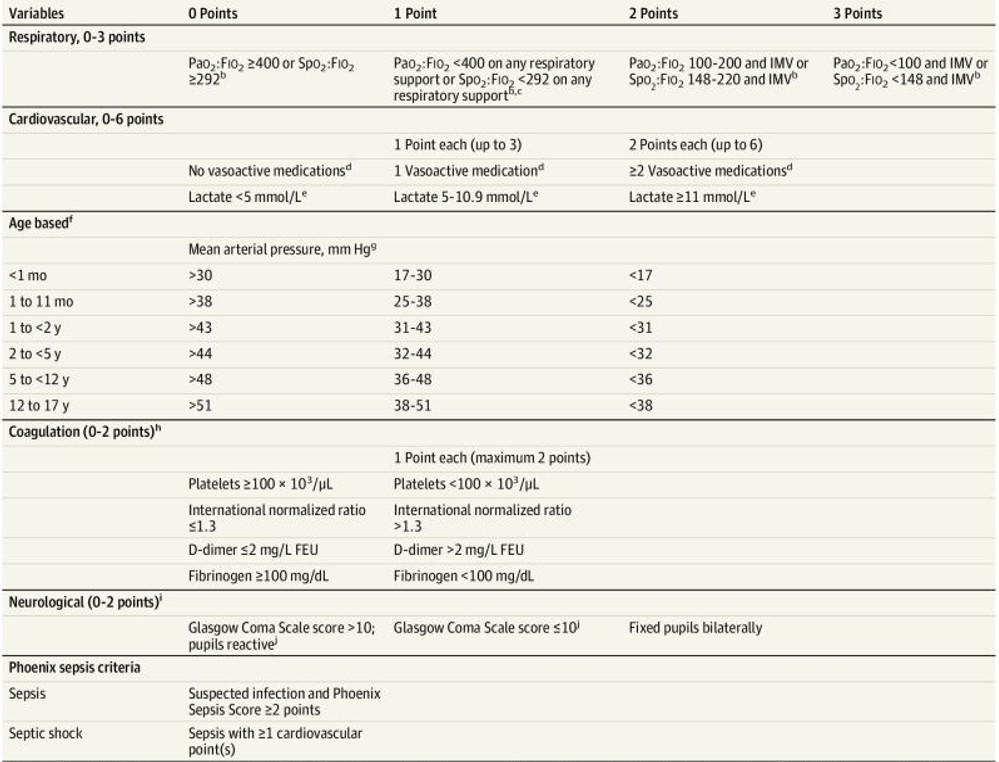
Laboratory parameters included complete blood count, C-reactive protein, procalcitonin, and blood culture results obtained within the same 6-hour window. The Phoenix Sepsis Score (Figure 1) and pSOFA were calculated from the most abnormal values recorded within the same 6-hour window. The pSOFA score incorporated six organ-system subscores (respiratory, coagulation, hepatic, cardiovascular, neurologic, and renal). For both scores, variables not measured within this window were assigned 0 points (treated as normal), consistent with standard scoring conventions. Score calculation was completed from the recorded clinical and laboratory data before analysis of hospital outcomes.
Treatment-related variables, including antibiotic therapy and modifications, fluid resuscitation, use of vasoactive agents, mechanical ventilation, length of hospital stay, and final outcome (survival or death), were recorded throughout hospitalization.
Statistical analysis
Data were analyzed using SPSS version 26.0 (IBM Corp., Armonk, NY, USA). Categorical variables were expressed as frequencies and percentages, whereas continuous variables were presented as means and standard deviations. Group comparisons were performed using the chi-square test or Fisher’s exact test for categorical variables and the independent-samples t test for continuous variables, as appropriate. Odds ratios (ORs) with 95% confidence intervals (CIs) were calculated. A p-value <0.05 was considered statistically significant.
The prognostic performance of the Phoenix Sepsis Score was evaluated using receiver operating characteristic (ROC) curve analysis. The area under the curve (AUC) with 95% CIs was calculated. The optimal cutoff point was determined using the Youden index.
Ethical considerations
This study was conducted in accordance with ethical principles for biomedical research involving human subjects. The study protocol was approved by the Can Tho University of Medicine and Pharmacy Ethics Committee (Approval code: 22.170.HV/PCT-HĐĐĐ) and received authorization from the Board of Directors of Can Tho Children’s Hospital. All patient-related information was anonymized and coded to ensure confidentiality. Informed consent was obtained from the parents or legal guardians of all participating children after a thorough explanation of the study’s objectives and procedures.
RESULTS
A total of 94 pediatric cases met the inclusion criteria and were included in the analysis. Table 1 presents the general characteristics of the study population. Children under 5 years of age accounted for 67.0% of the study population, while males accounted for 60.6%. There were no statistically significant associations between age group or sex and clinical outcomes. Additionally, 16 of the 94 patients were identified as malnourished, and 32 had a history of prior hospitalization.
| p-values were calculated using the chi-square test unless otherwise indicated. *Fisher’s exact test. CI, confidence interval; OR, odds ratio. | ||||||
| Table 1. General characteristics of the study population. | ||||||
| Characteristics |
|
|
|
|
|
|
| Age |
|
|
|
|
|
|
|
|
|
|
|
|||
| Sex |
|
|
|
|
|
|
|
|
|
|
|
|||
| Malnourished |
|
|
|
|
|
|
|
|
|
|
|
|||
| History of prior hospitalization |
|
|
|
|
|
|
|
|
|
|
|
|||
Clinical characteristics
The most commonly identified sources of infection were the gastrointestinal tract (46.8%) and the respiratory tract (44.7%). The mean recorded body temperature was 38.80 ± 0.72 °C, with no significant difference between outcome groups (p=0.825). GCS scores were higher among survivors than among non-survivors (14.19 ± 3.41 vs. 10.96 ± 3.61; p<0.001). For descriptive analysis, the Phoenix Sepsis Score was categorized using a threshold of <2 versus ≥2, consistent with the Phoenix criteria threshold for pediatric sepsis (Table 2).10
| Data are presented as mean ± SD or n (%). SD, standard deviation. | |||||
| Table 2. Selected clinical characteristics of pediatric patients with sepsis. | |||||
| Characteristics |
|
|
|
|
|
| Sources of infection | Respiratory tract |
|
|
|
|
| Gastrointestinal tract |
|
|
|
||
| Skin/soft tissue |
|
|
|
||
| Other |
|
|
|
||
| Temperature (°C) |
|
|
|
|
|
| Glasgow Coma Scale score |
|
|
|
|
|
| Tachycardia | Yes |
|
|
|
|
| No |
|
|
|
||
| Tachypnea | Yes |
|
|
|
|
| No |
|
|
|
||
| Clinical presentation | Septic shock |
|
|
|
|
| Sepsis |
|
|
|
||
| Blood culture result | Positive |
|
|
|
|
| Negative |
|
|
|
||
| Phoenix Sepsis Score | Total score <2 |
|
|
|
|
| Total score ≥2 |
|
|
|
||
Treatment outcomes in pediatric sepsis
Table 3 summarizes treatment outcomes. The mean length of hospital stay was 13.66 ± 10.73 days, with no statistically significant difference between outcome groups (p=0.206).
|
*Independent-samples t test. **Fisher’s exact test; unmarked p value, chi-square test. SD, standard deviation. |
|||||
| Table 3. Treatment outcomes in pediatric sepsis. | |||||
| Characteristics |
|
|
|
|
|
| Length of hospital stay (days) |
|
|
|
|
|
| Use of vasoactive agents |
|
|
|
|
|
|
|
|
|
|
||
| Mechanical ventilation |
|
|
|
|
|
|
|
|
|
|
||
| Antibiotic modification |
|
|
|
|
|
|
|
|
|
|
||
Vasoactive agents were used in 43 patients (45.7%), and 50 patients (53.2%) required mechanical ventilation. Both interventions were significantly associated with mortality (p<0.001). Antibiotic therapy was modified two or more times in 59 patients (62.8%); this was more frequent among non-survivors than survivors (80.8% vs. 55.9%; p=0.026).
Prognostic performance of the Phoenix Sepsis Score
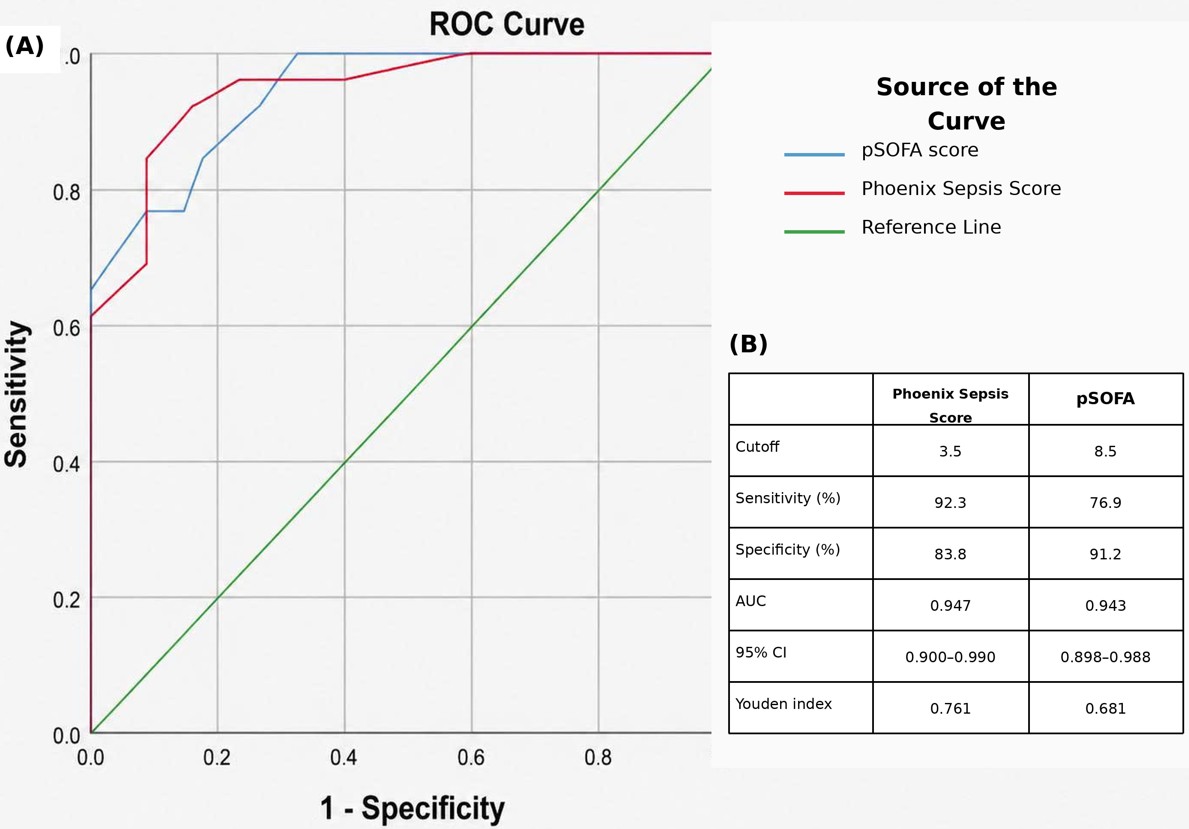
The Phoenix Sepsis Score and pediatric SOFA (pSOFA) score demonstrated comparable performance in predicting mortality. The AUC was 0.947 (95% CI, 0.90–0.99) for the Phoenix Sepsis Score and 0.943 (95% CI, 0.898–0.988) for pSOFA. The Phoenix Sepsis Score showed higher sensitivity than pSOFA (92.3% vs. 76.9%), whereas pSOFA showed higher specificity (91.2% vs. 83.8%). ROC analysis using the Youden index identified an optimal cutoff value of 3.5 for the Phoenix Sepsis Score (Figure 2).
DISCUSSION
In our cohort, children younger than 5 years accounted for a large proportion of sepsis-related deaths (69.2%). However, no statistically significant association between age and mortality was observed (p=0.778). This finding suggests that although younger children represent a clinically important subgroup, age alone may not predict mortality in this population. Previous large-scale analyses have reported increased vulnerability to severe infection among younger children, likely related to immunological immaturity and limited physiological reserve.3
Among clinical characteristics, GCS scores were lower in non-survivors than in survivors (10.96 ± 3.61 vs. 14.19 ± 3.41; p<0.001), and septic shock was more frequent in the non-survivor group (61.5% vs. 20.6%; p<0.001). This aligns with findings from the SPROUT study by Weiss et al. (2015), which highlighted altered mental status as an independent predictor of mortality in pediatric sepsis.13 The association between septic shock and increased mortality has also been emphasized in existing clinical guidelines.11
Treatment-related variables, including the use of vasoactive agents and mechanical ventilation, were more common among non-survivors (96.2% vs. 26.5% and 92.3% vs. 38.2%, respectively; p<0.001). These findings likely reflect greater illness severity in this group rather than direct causal effects. Similar observations have been reported in previous studies, where the need for organ support was associated with higher mortality risk in pediatric sepsis.14
Frequent modification of antibiotic therapy was also more common among non-survivors, with 80.8% requiring two or more modifications compared with 55.9% of survivors (p=0.026). This may reflect challenges such as delayed appropriate therapy, treatment refractoriness, or infections caused by resistant pathogens. This aligns with Lane et al., who showed that antibiotic delays beyond 330 minutes independently increased mortality in a large pediatric sepsis cohort.15 Repeated regimen changes may also indicate clinical instability requiring escalation or de-escalation, as described by Battula et al. in critically ill children with sepsis.16 A likely underlying driver is antimicrobial resistance: Kalın et al. reported that multidrug-resistant pathogens frequently delay adequate coverage and necessitate repeated empirical escalation.17
In this study, both the Phoenix Sepsis Score and the pSOFA score demonstrated high discriminative ability for predicting mortality, with AUC values of 0.947 and 0.943, respectively. The Phoenix Sepsis Score showed higher sensitivity (92.3%), whereas pSOFA demonstrated higher specificity (91.2%). These results suggest that both scoring systems may have value in clinical practice, depending on the intended use. The optimal cutoff of 3.5 points identified in our analysis differs from the threshold of ≥2 points used to define pediatric sepsis in the Phoenix criteria.10 This difference reflects the distinct purposes of classification and prognostication: whereas the ≥2 threshold is used to identify sepsis, higher cutoffs may provide improved discrimination for predicting mortality.
However, variability in the performance of the Phoenix Sepsis Score across studies has been reported. For example, Hadzhieva-Hristova et al.18 reported a lower AUC of 0.736. Differences in sample size, patient populations, clinical practices, and particularly the timing of score assessment may contribute to this variability. Inconsistent timing of score calculation, including assessments performed at different points within the first 24 hours, may introduce heterogeneity in disease severity and affect predictive performance. These findings suggest that standardization of the timing of score assessment may improve comparability across studies.
At the optimal cutoff of 8.5 points, the pSOFA score yielded a sensitivity of 76.9% and specificity of 91.2%, with a positive predictive value of 76.9% and negative predictive value of 91.2%. These findings are comparable to those reported by Matics and Sanchez-Pinto, who observed an AUC of 0.912 in their validation cohort, supporting the consistent performance of pSOFA across different pediatric populations.19
CONCLUSION
In this study, several clinical and treatment-related factors, including lower GCS scores, septic shock, and the need for organ support, were associated with increased mortality in pediatric sepsis. Although children younger than 5 years accounted for a large proportion of cases, age was not significantly associated with mortality.
The Phoenix Sepsis Score demonstrated high discriminative ability for predicting mortality, with performance comparable to the pSOFA score. The Phoenix Sepsis Score showed higher sensitivity, whereas pSOFA demonstrated higher specificity, suggesting that both scores may have complementary roles depending on clinical priorities. Accordingly, the Phoenix Sepsis Score may be useful as a supportive tool for early risk stratification in pediatric sepsis. Further multicenter studies are needed to validate these findings and to determine its optimal clinical application.
Limitations
This study has several limitations. First, it was conducted at a single center with a relatively small sample size, which may limit generalizability and reduce the ability to detect smaller differences in predictive performance between scoring systems. Although patients were identified using SIRS-based criteria according to the 2012 Surviving Sepsis Campaign and IPSCC definitions, the Phoenix Sepsis Score was subsequently applied for prognostic assessment based on organ dysfunction. The use of these different classification frameworks may have influenced the observed predictive performance. Second, the Phoenix Sepsis Score was assessed only at the time of initial diagnosis, without evaluating dynamic changes over time. Although data were collected within the first 6 hours, variability in clinical practice may have affected the timing and completeness of measurements. In addition, the threshold of ≥2 antibiotic modifications was not based on an established clinical cutoff and therefore should be interpreted with caution. While the Phoenix Sepsis Score relies on a relatively limited set of routinely available clinical and laboratory parameters, its applicability may still vary across resource-limited settings. Finally, the mortality estimate used for sample size calculation was derived from local data rather than published sources, which may limit external comparability.
Acknowledgements
The authors would like to express their sincere gratitude to the doctors, nurses, and entire pediatric intensive care team at Can Tho Children’s Hospital for their invaluable support and cooperation during this study. We also extend our thanks to Can Tho University of Medicine and Pharmacy for providing academic guidance and institutional support throughout the research process.
Ethical approval
This study was approved by the Ethics Committee of Can Tho University of Medicine and Pharmacy (Date: Not reported, Decision/Protocol No: 22.170.HV/PCT-HĐĐĐ). Informed consent was obtained from all participants involved in this study.
Data availability statement
The data that support the findings of this study are available from the corresponding author upon reasonable request.
Conflict of interest
The authors declare that this study was conducted in the absence of any commercial or financial relationships that could be construed as a potential conflict of interest.
Funding
The authors declare that this study received no funding.
Generative AI statement
The authors declare that no generative AI or AI-assisted technologies were used in the writing or preparation of this study.
References
- Kwizera A, Urayeneza O, Mujyarugamba P, et al. Epidemiology and outcome of sepsis in adults and children in a rural, Sub-Sahara African setting. Crit Care Explor. 2021;3:e0592. https://doi.org/10.1097/CCE.0000000000000592
- Southeast Asia Infectious Disease Clinical Research Network. Causes and outcomes of sepsis in southeast Asia: a multinational multicentre cross-sectional study. Lancet Glob Health. 2017;5:e157-67. https://doi.org/10.1016/S2214-109X(17)30007-4
- Rudd KE, Johnson SC, Agesa KM, et al. Global, regional, and national sepsis incidence and mortality, 1990-2017: analysis for the Global Burden of Disease Study. Lancet. 2020;395:200-11. https://doi.org/10.1016/S0140-6736(19)32989-7
- Singer M, Deutschman CS, Seymour CW, et al. The third international consensus definitions for sepsis and septic shock (Sepsis-3). JAMA. 2016;315:801-10. https://doi.org/10.1001/jama.2016.0287
- Mahapatra S, Heffner AC. Septic shock. In: StatPearls. Treasure Island (FL): StatPearls Publishing; 2025. Available at: https://www.ncbi.nlm.nih.gov/books/NBK430939/ (Accessed on Jul 19, 2025).
- Lanziotti VS, Ventura A, Kache S, Fernández-Sarmiento J. New Phoenix criteria for pediatric sepsis and septic shock: the strengths and the future of a comprehensive perspective. Crit Care Sci. 2024;36:e20240058en. https://doi.org/10.62675/2965-2774.20240058-en
- Toltzis P, Remy KE. New criteria for pediatric sepsis: a phoenix rising. J Pediatr Pharmacol Ther. 2024;29:676-8. https://doi.org/10.5863/1551-6776-29.6.676
- Bui QN, Ha TH, Duong LM, et al. Performance of SOFA score in predicting the risk of mortality in children with sepsis. Arch Balk Med Union. 2023;58:25-32. https://doi.org/10.31688/ABMU.2023.58.1.03
- Buderer NM. Statistical methodology: I. Incorporating the prevalence of disease into the sample size calculation for sensitivity and specificity. Acad Emerg Med. 1996;3:895-900. https://doi.org/10.1111/j.1553-2712.1996.tb03538.x
- Schlapbach LJ, Watson RS, Sorce LR, et al. International consensus criteria for pediatric sepsis and septic shock. JAMA. 2024;331:665-74. https://doi.org/10.1001/jama.2024.0179
- Dellinger RP, Levy MM, Rhodes A, et al. Surviving sepsis campaign: international guidelines for management of severe sepsis and septic shock: 2012. Crit Care Med. 2013;41:580-637. https://doi.org/10.1097/CCM.0b013e31827e83af
- Goldstein B, Giroir B, Randolph A; International Consensus Conference on Pediatric Sepsis. International pediatric sepsis consensus conference: definitions for sepsis and organ dysfunction in pediatrics. Pediatr Crit Care Med. 2005;6:2-8. https://doi.org/10.1097/01.PCC.0000149131.72248.E6
- Weiss SL, Fitzgerald JC, Pappachan J, et al. Global epidemiology of pediatric severe sepsis: the sepsis prevalence, outcomes, and therapies study. Am J Respir Crit Care Med. 2015;191:1147-57. https://doi.org/10.1164/rccm.201412-2323OC
- Schlapbach LJ, Straney L, Bellomo R, MacLaren G, Pilcher D. Prognostic accuracy of age-adapted SOFA, SIRS, PELOD-2, and qSOFA for in-hospital mortality among children with suspected infection admitted to the intensive care unit. Intensive Care Med. 2018;44:179-88. https://doi.org/10.1007/s00134-017-5021-8
- Lane RD, Richardson T, Scott HF, et al. Delays to antibiotics in the emergency department and risk of mortality in children with sepsis. JAMA Netw Open. 2024;7:e2413955. https://doi.org/10.1001/jamanetworkopen.2024.13955
- Battula V, Krupanandan RK, Nambi PS, Ramachandran B. Safety and feasibility of antibiotic de-escalation in critically ill children with sepsis - a prospective analytical study from a pediatric ICU. Front Pediatr. 2021;9:640857. https://doi.org/10.3389/fped.2021.640857
- Kalın G, Alp E, Chouaikhi A, Roger C. Antimicrobial multidrug resistance: clinical implications for infection management in critically ill patients. Microorganisms. 2023;11:2575. https://doi.org/10.3390/microorganisms11102575
- Hadzhieva-Hristova A, Krumova D, Stoeva T, Georgieva R, Iotova V. Assessment of Phoenix Sepsis Score, pSOFA, PELOD-2, and PRISM III in pediatric intensive care. Children (Basel). 2025;12:262. https://doi.org/10.3390/children12030262
- Matics TJ, Sanchez-Pinto LN. Adaptation and validation of a Pediatric Sequential Organ Failure Assessment Score and evaluation of the Sepsis-3 definitions in critically Ill children. JAMA Pediatr. 2017;171:e172352. https://doi.org/10.1001/jamapediatrics.2017.2352
Copyright and license
Copyright © 2026 The author(s). This is an open-access article published by Aydın Pediatric Society under the terms of the Creative Commons Attribution License (CC BY) which permits unrestricted use, distribution, and reproduction in any medium or format, provided the original work is properly cited.