

Abstract
Background: A limited number of studies have shown that fermented milk products (FMPs) regularly consumed by mothers during pregnancy may be beneficial for atopic dermatitis and food allergy in their children. In this study, we aimed to investigate the effect of regular maternal consumption of yogurt and cheese during pregnancy on the remission period of cow’s milk protein allergy (CMPA) in their children.
Methods: In this retrospective cohort study, 59 consecutive children who presented to the pediatric allergy outpatient clinic between January 2020 and January 2023 and were evaluated for IgE-mediated CMPA were screened; 19 were excluded (incomplete data, non-IgE-mediated findings, or declined participation), leaving 40 children for analysis. The diagnosis of CMPA was made by skin prick test (SPT) and/or cow’s milk-specific IgE and oral food challenge (OFC). Demographic characteristics, laboratory data, duration of tolerance development and frequency of regular FMP consumption by mothers during pregnancy were recorded using a structured questionnaire.
Results: Among cases, 42.5% were girls and 57.5% were boys. The median age of cases was 38.5 months (24-47.75). The median duration of breast milk intake was 20 months (14-24). Parental atopy was present in 45% of cases. The median age at symptom onset was 4.5 (2-6) months. Prediagnoses at presentation included atopic dermatitis in 57.5%, allergic proctocolitis in 5%, urticaria and angioedema in 32.5%, and anaphylaxis in 5%. The median cow’s milk SPT wheal diameter was 8 (5-13) mm, yogurt SPT wheal diameter was 5 (0-10) mm, and cow’s milk-specific IgE value was 0.66 (0.13-5.68) kU/L. Baked cow’s milk products were tolerated by 67.5% of subjects. Prevalence of daily FMP consumption during pregnancy was 55%, yogurt consumption was 62.5%, and cheese consumption was 70%. Although there was no significant difference between subgroups in age at onset of clinical symptoms, the age at first tolerance to cow’s milk, duration of tolerance development and yogurt SPT wheal diameter were significantly lower in children of mothers who consumed FMPs daily during pregnancy compared with those who did not (p<0.05); this lower yogurt wheal diameter may in part reflect a milder baseline sensitization profile in this subgroup. Age at symptom onset was correlated with serum total IgE and cow’s milk-specific IgE.
Conclusion: The duration of remission of CMPA in offspring was found to be shorter if the mother used FMPs daily during pregnancy.
Keywords: cow’s milk allergy, fermented food, skin prick test, cow’s milk-specific IgE, milk, yogurt, tolerance
INTRODUCTION
Cow’s milk protein allergy (CMPA) represents one of the most common food allergies in early childhood, affecting 2-3% of infants worldwide.1 While this condition typically resolves naturally over time, the journey to tolerance can be lengthy and challenging for both children and their families. Recent scientific attention has turned to preventive strategies, particularly the role of maternal diet during pregnancy in modulating allergic outcomes in offspring.2-4
Dysbiosis is a condition in which the microbiota balance is disturbed by changing the content and quantity of bacteria.5 Dysbiosis is thought to affect the function of the intestinal barrier and basophil and type 2 immune responses and has been proposed as a contributing mechanism to allergic responses.6
Fermentation is a natural food chemical processing method that occurs through the action of microorganisms in the organic structure of foodstuffs.7-9 Fermented dairy products, with their rich probiotic content and modified protein structures, have emerged as potential modulators of immune response.8-10 These products, particularly yogurt and cheese, have been traditionally consumed across various cultures for their nutritional benefits. Fermented foods contain bioactive compounds, antioxidants, antimicrobial enzymes, essential amino acids, vitamins, probiotics, and prebiotics.8,9,11 They play an important role in the formation of the intestinal microbiota.8,9 However, their specific impact on allergic conditions, especially when consumed during pregnancy, remains an understudied area of considerable interest.
Previous research has suggested associations between maternal consumption of fermented foods during pregnancy and reduced risk of atopic conditions in children.12-15 However, limited data exist specifically examining the relationship between maternal fermented dairy intake during pregnancy and the natural history of CMPA in offspring. Our study addresses this critical knowledge gap by investigating whether regular consumption of fermented dairy products during pregnancy influences the duration of IgE-mediated CMPA in children.
METHODS
Participant characteristics
This was a retrospective cohort study; the primary outcomes (age at tolerance and time to tolerance) were assessed longitudinally. All consecutive children aged 0-18 years with IgE-mediated CMPA admitted between January 2020 and January 2023 were screened for eligibility.
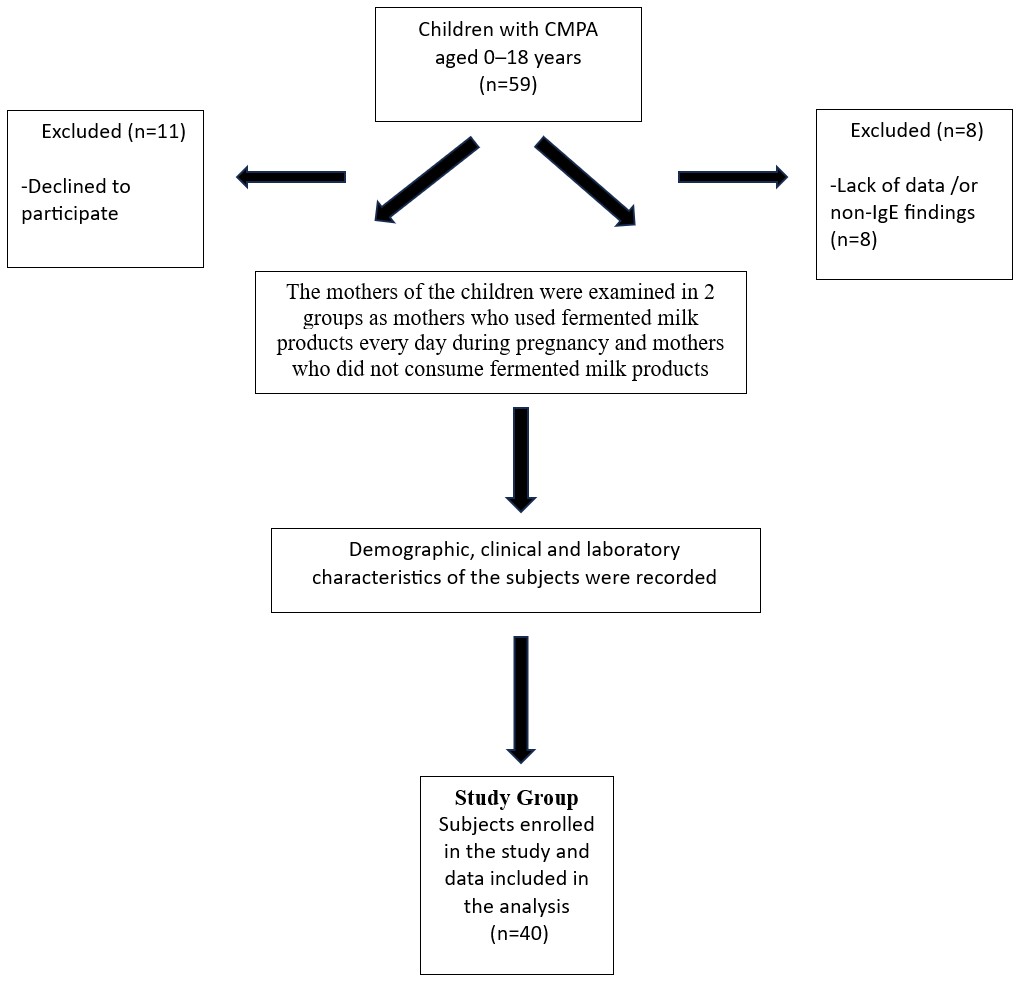
Detailed information concerning the patients included in the study is shown in the flowchart in Figure 1.
Case report form and data collection
The variety and frequency of fermented milk products (FMPs) used by the mothers during pregnancy were assessed by telephone interview using a structured questionnaire. Consumption of yogurt and cheese as FMP was recorded and categorized as “every day” versus “not every day” for each product, following the classification used by Koksal et al. in a comparable cohort of mothers and their children with CMPA.12
The definition of fermented milk product was based on the consumption of cheese and yogurt.
Cow’s milk oral food challenge (OFC) and skin prick test procedures: Oral food challenges were performed in hospital under physician supervision using a graded, incremental-dose protocol for cow’s milk, adapted from the cow’s milk product ladder and OFC dosing schedule of the Turkish National Food Challenge Guideline (2019)16; the challenge was terminated at the first objective sign of an IgE-mediated reaction and considered negative if no reaction occurred after the cumulative target volume was tolerated. Baked cow’s milk products were defined, per the same national guideline, as products baked at 180–200 °C for approximately 30 minutes (e.g., biscuits, cakes, muffins, or pastries) containing less than 1 g of cow’s milk protein per serving (Step 1 of the cow’s milk product ladder); baked-milk tolerance was confirmed by an open OFC with the baked product without objective reaction. Skin prick tests were performed with commercial allergen extracts together with saline (negative) and histamine (positive) controls; wheals were read at 15–20 minutes, and a wheal diameter ≥3 mm greater than the negative control was considered positive, in keeping with standard national practice.
The mothers were divided into 2 subgroups according to whether they consumed FMPs every day or not every day during pregnancy and were compared. Demographic, clinical and laboratory characteristics of the subjects were recorded.
Exclusion criteria
Of 59 consecutively screened patients, 19 were excluded due to incomplete data, non-IgE-mediated laboratory findings, or declined participation. Patients presenting with a clinical phenotype of allergic proctocolitis were retained in the analysis where biochemical evidence of IgE-mediated sensitization (a positive skin prick test and/or cow’s milk-specific IgE) was documented; proctocolitis is more commonly a non-IgE-mediated entity, and we clarify this point here because it was not stated explicitly in the original submission.
CMPA diagnosis
The diagnosis of CMPA was made by cow’s milk-specific IgE measurement, skin prick test (SPT), diagnostic elimination diet and oral food challenge, together with a thorough clinical history.17
Sample size
A total of 40 children diagnosed with CMPA who underwent oral food challenge were included in the study retrospectively. A formal a priori sample size or power calculation was not performed, as this was a retrospective analysis of consecutively available patients over the study period; this is acknowledged as a limitation.
Ethics
This study was approved by the local institutional ethics committee (protocol no. 2023/63). The research was conducted in conformity with the principles of the Declaration of Helsinki. Informed consent was obtained from the children’s parents or legal guardians.
Statistical analysis
Statistical analyses were performed using the IBM SPSS Statistics version 27.0 software (IBM Corp., Armonk, NY, USA). The data obtained were expressed as percentage (%), mean ± SD and median (25th–75th percentile, IQR). Within-group values were analyzed with parametric and nonparametric tests according to the nature of the data. Chi-square or Fisher’s exact test was used to analyze categorical variables, and odds ratios (OR) with 95% confidence intervals (CI) are reported where appropriate. Differences between the two groups were evaluated with Student t test or Mann-Whitney U test; for the latter, rank-biserial correlation is reported as a measure of effect size. A post hoc exploratory multivariable logistic regression analysis was performed to assess whether egg allergy and other food allergy independently predicted baked cow’s milk tolerance, with discrimination summarized by the area under the receiver operating characteristic curve (AUC). A p-value <0.05 was considered statistically significant.
RESULTS
Patient characteristics
Fifty-nine children were initially screened for the study, of whom 19 were subsequently excluded for the reasons detailed in the Methods, leaving 40 children for final analysis. Detailed participation information is shown in the flowchart (Figure 1).
There was no significant difference between the subgroups defined by maternal daily FMP consumption in terms of the demographic characteristics of sex, age, weight, height or BMI SDS (p>0.05).
The median duration of breastfeeding was 20 months. Parental atopy was present in 45% (18) of the patients. The most common presenting complaint was rash, itching, and swelling in 90% (36) of the patients. The most common clinical diagnosis at presentation was atopic dermatitis in 57.5% (23). This diagnosis was followed by urticaria and angioedema in 32.5% (13), proctocolitis in 5% (2), and anaphylaxis in 5% (2), in order of frequency (Table 1).
| BMI: body mass index, FMP: fermented milk product, FX5: specific IgE screening panel for a mixture of common food allergens (egg white, milk, fish, wheat, peanut, and soybean), IgE: immunoglobulin E, IQR: interquartile range, SDS: standard deviation score, SPT: skin prick test. | |
| Table 1. Demographic characteristics of patients with cow's milk allergy. | |
| Demographic measures | |
| Sex, n=40 (%) | |
| Girl |
|
| Boy |
|
| Age (months); median (IQR) |
|
| Weight SDS, median (IQR) |
|
| Height SDS, median (IQR) |
|
| BMI SDS, median (IQR) |
|
| Parental atopy, n (%) | |
| Yes |
|
| No |
|
| Age at symptom onset (months); median (IQR) |
|
| Clinical diagnosis, n (%) | |
| Atopic dermatitis |
|
| Allergic proctocolitis |
|
| Urticaria and angioedema |
|
| Anaphylaxis |
|
| Presenting complaint, n (%) | |
| Rash, itching, and swelling |
|
| Anaphylaxis |
|
| Number of patients tolerating baked cow’s milk, n (%) |
|
| Number of patients tolerating any dairy product other than baked cow’s milk, n (%) |
|
| Frequency of consuming FMPs (yogurt and cheese) during pregnancy, n (%) | |
| Every day: |
|
| Not every day: |
|
| Frequency of yogurt consumption during pregnancy, n (%) | |
| Every day: |
|
| Not every day: |
|
| Frequency of cheese consumption during pregnancy, n (%) | |
| Every day: |
|
| Not every day: |
|
| Duration of cow’s milk tolerance (months), median (IQR) |
|
| Age at cow’s milk tolerance (months), median (IQR) |
|
| Laboratory: | |
| Skin prick test (SPT) wheal diameters (mm), median (IQR) | |
| Milk |
|
| Yogurt |
|
| Alpha-lactalbumin, n=11 |
|
| Beta-lactoglobulin |
|
| Casein, n=24 |
|
| FX5 (kU/L), median (IQR) |
|
| Cow’s milk-specific IgE (kU/L), median (IQR) |
|
| Total IgE (IU/mL), median (IQR), n=16 |
|
Baked cow’s milk protein was tolerated by 67.5% (27) of patients. The frequency of consumption of fermented milk products (yogurt/cheese) during pregnancy was 55% (22) for mothers who consumed them every day and 45% (18) for mothers who did not consume them every day (Table 1).
In patients who tolerated cow’s milk, the median duration of tolerance was 17.5 months, and the median age of tolerance was 21.5 months (Table 1).
When patients with CMPA were compared according to the mother’s daily consumption of cheese and yogurt during pregnancy, the age at first tolerance to cow’s milk protein was younger, the time to develop tolerance was shorter, and the number of patients who tolerated cow’s milk protein in total (baked or unbaked) was higher (p<0.05) (Table 2).
| IgE: immunoglobulin E, SPT: skin prick test. Laboratory comparisons were performed only in patients with available measurements for each biomarker; subset sizes for casein-specific IgE and alpha-lactalbumin/beta-lactoglobulin are reported in Table 1. | |||
| Table 2. Comparison of the frequency of fermented milk products consumed by the mother during pregnancy with clinical and laboratory data. | |||
|
|
|
|
|
| Age at first tolerance to cow’s milk (months) |
|
|
|
| Time to development of cow’s milk tolerance (months) |
|
|
|
| Age at clinical onset (months) |
|
|
|
| Number of patients tolerating baked cow’s milk, n (%) |
|
|
|
| Presence of parental atopy, n (%) |
|
|
|
| Egg allergy, n (%) |
|
|
|
| Other food allergy, n (%) |
|
|
|
| Number of patients tolerating non-baked cow’s milk products, n (%) |
|
|
|
| Duration of breastfeeding (months) |
|
|
|
| Cow’s milk-specific IgE (kU/L) |
|
|
|
| Total IgE (IU/mL) |
|
|
|
| SPT wheal diameter (mm) | |||
| Milk |
|
|
|
| Yogurt |
|
|
|
| Casein |
|
|
|
| Alpha-lactalbumin |
|
|
|
| Beta-lactoglobulin |
|
|
|
Laboratory
The median FX5 (a screening panel of specific IgE to a mixture of common food allergens: egg white, milk, fish, wheat, peanut, and soybean) value was 1.74 kU/L, cow’s milk-specific IgE was 0.66 kU/L, and total IgE level was 63.25 IU/mL in children with CMPA (Table 1).
When patients with CMPA were compared according to the mother’s daily consumption of cheese and yogurt during pregnancy, no difference was observed in total IgE or cow’s milk-specific IgE values between children of mothers who consumed cheese and yogurt daily and children of mothers who did not, but yogurt SPT wheal diameter was found to be lower in children of mothers who consumed yogurt daily (p=0.027) (Table 2). As baseline sensitization severity was not adjusted for, this finding may partly reflect a milder underlying allergic phenotype in this subgroup rather than a direct effect of maternal FMP intake and should be interpreted with caution.
Correlation analysis
According to Pearson correlation analysis, there was a moderate positive correlation between age at symptom onset and serum total IgE (r=0.647, p=0.007).
There was a moderate positive correlation between age at symptom onset and serum cow’s milk-specific IgE (r=0.523, p=0.002).
We assessed whether egg allergy or other food allergy (positive SPT to soy, wheat, peanut, hazelnut, walnut, fish, beef, or lentil) independently predicted tolerance to baked cow’s milk products using multivariable logistic regression. Neither egg allergy (OR 1.72, 95% CI 0.40-7.44, p=0.47) nor other food allergy (OR 0.58, 95% CI 0.13-2.51, p=0.47) was an independent predictor, and the model showed poor discrimination (AUC 0.56), likely reflecting the limited sample size; this should be regarded as hypothesis-generating rather than confirmatory. We also examined whether symptom severity at presentation (presence of anaphylaxis) was associated with age at tolerance acquisition, but only 2 of 40 patients presented with anaphylaxis, precluding a statistically meaningful comparison. For the main between-subgroup comparisons in Table 2, effect sizes are as follows: age at first cow’s milk tolerance (rank-biserial r=0.95) and tolerance development time (r=0.91) were both very large, and the odds of tolerating baked cow’s milk products were substantially higher in children of mothers with daily FMP consumption (OR 42.0, 95% CI 4.50-391.65), although the wide confidence interval reflects the small cell counts involved.
DISCUSSION
Our study demonstrated that regular maternal consumption of FMPs during pregnancy was associated with shorter remission periods of CMPA in offspring. This finding aligns with and extends previous research in the field of maternal diet and childhood allergies.
Previous case-control studies have shown that lower consumption of yogurt, tarhana, and kefir during pregnancy is associated with increased risk of infant secondary protein allergy (CMPA).7,9,11-13,18 Our study extends these findings by showing that daily maternal consumption of FMPs during pregnancy was associated with differences in cow’s milk allergy progression. Children of mothers who consumed FMPs daily showed lower ages of milk tolerance, shorter tolerance development periods, and smaller yogurt SPT wheal diameters. Given the retrospective, observational design, these associations may reflect an immunomodulatory effect of maternal FMP intake, but they may equally reflect unmeasured confounding (e.g., baseline sensitization severity, maternal atopy, or other dietary factors), and causality cannot be inferred.
Previous retrospective case-control research has illuminated the potential protective role of maternal fermented dairy product consumption during pregnancy against allergic conditions.19 Specifically, studies investigating the impact of FMPs on allergic proctocolitis revealed that lower daily consumption of these products was associated with increased incidence of the condition.19,20 Additionally, daily consumption of a variety of FMPs, including yogurt, cheese, and tarhana, demonstrated a protective effect against allergic proctocolitis in infants.19 Our findings are broadly consistent with this body of research, providing additional observations on the relationship between maternal diet and infant immune responses. While previous studies primarily focused on the presence or absence of allergic proctocolitis, our study extends this by examining cow’s milk tolerance timing specifically. These results support the importance of maternal dietary choices during pregnancy as one of several factors potentially relevant to allergic outcomes in offspring.
Prior research has reported potential protective effects of maternal dietary interventions on atopic dermatitis (AD) development in children. Retrospective case-control studies have reported that daily yogurt consumption during pregnancy is associated with reduced AD risk.13 A comprehensive systematic review and meta-analysis involving 28 studies and 6,907 participants further substantiated these findings, revealing that maternal probiotic supplementation during pregnancy and early postpartum period substantially decreased AD incidence in children.15 A notable cohort study tracking infants from birth to six years confirmed these observations, showing markedly reduced AD risk in children whose mothers received probiotic support during pregnancy and early infancy.14 In our study, 57.5% of cases presented with atopic dermatitis, and milk allergy progression varied with maternal FMP consumption; children of mothers who consumed FMPs daily showed lower ages of milk tolerance and smaller yogurt SPT wheal diameters. These observations are directionally consistent with prior research on probiotic supplementation and AD prevention, though the mechanisms cannot be confirmed by our study design.
Research involving diverse populations, including Western and Japanese cohorts, demonstrated that high maternal consumption of dairy products and calcium during pregnancy was associated with reduced risks of infantile wheezing, asthma, and atopic dermatitis in children aged 16-29 months.21 Similarly, our study examines the specific impact of FMPs on CMPA progression, adding to this literature on maternal diet and infant allergic outcomes.
Children of mothers who consumed FMPs daily showed significantly lower ages of milk tolerance and shorter tolerance-development periods, consistent with prior evidence that maternal dietary interventions may modulate offspring immune responses.2,22 This finding—that the duration of CMPA remission was shorter in children of mothers consuming daily FMPs—adds a further, more specific data point to the literature on maternal nutrition and allergic disease progression, while the associative, non-causal nature of this observation should be kept in mind.
The variability in allergic outcomes across different studies, including our own, underscores the need for comprehensive, longitudinal research to fully understand the immunomodulatory effects of maternal diet. While previous studies focused on broad allergic conditions, our research offers detailed insights into milk allergy tolerance mechanisms, suggesting that the impact of maternal nutrition extends beyond simple risk reduction to potentially influencing the fundamental immunological responses in offspring.
The strengths of our study include that all patients were evaluated in a single pediatric allergy and immunology center, that only patients with IgE-mediated CMPA (confirmed by SPT and/or cow’s milk-specific IgE) were included, that an OFC was performed in all patients to confirm the diagnosis, that mothers were likely to recall their pregnancy diet accurately given the young age of the patient group, and that mothers were asked about consumption over the entire pregnancy rather than a single time point.
Limitations of our study include its retrospective, single-center design and its relatively small sample size, which limits statistical power and precludes robust multivariable or ROC-based predictive modeling; the exploratory multivariable analysis reported above should be interpreted accordingly. Casein-specific IgE was not measured in all patients, reflecting the retrospective nature of data collection, although an OFC confirming the diagnosis was performed in every patient. Baseline sensitization severity was not formally adjusted for in the subgroup comparisons, so differences such as the lower yogurt SPT wheal diameter in the daily-FMP subgroup cannot be fully separated from a milder baseline allergic phenotype. We did not collect data on maternal or infant antibiotic or probiotic exposure, so the potential role of dysbiosis discussed in the Introduction remains speculative in the context of our findings and was not directly tested. The questionnaire-based assessment of maternal FMP consumption may be subject to recall bias, and as an observational, retrospective study, our design cannot establish causality between maternal FMP consumption and the timing of CMPA remission. Future prospective studies with larger cohorts, a priori sample size calculations, and more detailed dietary and microbiome assessments would be valuable to confirm and extend these findings.
CONCLUSION
Although no significant differences were observed in terms of the amount or variety of FMP consumption by mothers during pregnancy, the duration until tolerance in their children was shorter when mothers consumed yogurt and cheese every day. If confirmed in larger, prospective studies, these findings could have implications for prenatal dietary counseling. While further prospective studies with larger cohorts are needed to validate these findings, our research suggests that regular consumption of fermented dairy products during pregnancy could plausibly be associated with a shorter duration of CMPA in children. Such an association, if causal, could meaningfully affect quality of life for affected families and reduce the associated healthcare burden. However, it is essential to interpret these findings within the context of the study’s retrospective, observational nature and sample size limitations, which preclude any causal inference. Future research should focus on elucidating the specific mechanisms through which maternal FMP consumption may relate to allergic outcomes in offspring, as well as determining optimal consumption patterns for maximum benefit.
Key message
CMPA remains a considerable challenge in early childhood. Our exploratory, retrospective study raises the possibility of a preventive role for maternal diet modification, suggesting that regular consumption of fermented dairy products during pregnancy may be associated with a shorter duration of CMPA in offspring. Building on existing knowledge of the potential immunomodulatory properties of fermented dairy, our findings show that children born to mothers who regularly consumed these products during pregnancy developed tolerance earlier and showed smaller yogurt skin prick test wheal diameters. These observations point to a potentially simple dietary strategy worth testing prospectively in expecting mothers. For healthcare providers, this research offers preliminary support for considering fermented dairy products as part of prenatal dietary counseling, though confirmatory research is needed before any practice recommendation can be made. Our findings highlight the potential role of maternal nutrition during pregnancy in shaping children’s immune responses and suggest a testable pathway for potentially reducing the burden of milk protein allergy in early childhood.
Ethical approval
This study was approved by the Aydın Adnan Menderes University Medical Faculty Local Institutional Ethics Committee (Decision/Protocol No: 2023/63). Informed consent was obtained from all participants involved in this study.
Data availability statement
The data that support the findings of this study are available from the corresponding author upon reasonable request.
Conflict of interest
The authors declare that this study was conducted in the absence of any commercial or financial relationships that could be construed as a potential conflict of interest.
Funding
This study was supported by Adnan Menderes University Scientific Research Projects.
Generative AI statement
The authors declare that no generative AI or AI-assisted technologies were used in the writing or preparation of this study.
References
- Çatak J, Demirci A, Yaman M. Besin alerjileri ve mikrobiyota. EJOSAT. 2021: 902-10. https://doi.org/10.31590/ejosat.932606
- Willers SM, Wijga AH, Brunekreef B, et al. Maternal food consumption during pregnancy and the longitudinal development of childhood asthma. Am J Respir Crit Care Med. 2008;178:124-31. https://doi.org/10.1164/rccm.200710-1544OC
- Walker RW, Clemente JC, Peter I, Loos RJF. The prenatal gut microbiome: are we colonized with bacteria in utero? Pediatr Obes. 2017;12(Suppl 1):3-17. https://doi.org/10.1111/ijpo.12217
- Vuillermin PJ, Macia L, Nanan R, Tang ML, Collier F, Brix S. The maternal microbiome during pregnancy and allergic disease in the offspring. Semin Immunopathol. 2017;39:669-75. https://doi.org/10.1007/s00281-017-0652-y
- Lee KH, Song Y, Wu W, Yu K, Zhang G. The gut microbiota, environmental factors, and links to the development of food allergy. Clin Mol Allergy. 2020;18:5. https://doi.org/10.1186/s12948-020-00120-x
- Wang J, Zheng S, Yang X, Huazeng B, Cheng Q. Influences of non-IgE-mediated cow’s milk protein allergy-associated gut microbial dysbiosis on regulatory T cell-mediated intestinal immune tolerance and homeostasis. Microb Pathog. 2021;158:105020. https://doi.org/10.1016/j.micpath.2021.105020
- Kabak B, Dobson ADW. An introduction to the traditional fermented foods and beverages of Turkey. Crit Rev Food Sci Nutr. 2011;51:248-60. https://doi.org/10.1080/10408390903569640
- Heinen E, Ahnen RT, Slavin J. Fermented foods and the gut microbiome. Nutr Today. 2020;55:163-7. https://doi.org/10.1097/NT.0000000000000422
- Leeuwendaal NK, Stanton C, O’Toole PW, Beresford TP. Fermented foods, health and the gut microbiome. Nutrients. 2022;14:1527. https://doi.org/10.3390/nu14071527
- Shiferaw Terefe N, Augustin MA. Fermentation for tailoring the technological and health related functionality of food products. Crit Rev Food Sci Nutr. 2020;60:2887-913. https://doi.org/10.1080/10408398.2019.1666250
- Mota de Carvalho N, Costa EM, Silva S, Pimentel L, Fernandes TH, Pintado ME. Fermented foods and beverages in human diet and their influence on gut microbiota and health. Fermentation. 2018;4:90. https://doi.org/10.3390/fermentation4040090
- Koksal ZG, Uysal P, Mercan A, Bese SA, Erge D. Does maternal fermented dairy products consumption protect against cow’s milk protein allergy in toddlers? Ann Allergy Asthma Immunol. 2023;130:333-339. https://doi.org/10.1016/j.anai.2022.12.024
- Celik V, Beken B, Yazicioglu M, Ozdemir PG, Sut N. Do traditional fermented foods protect against infantile atopic dermatitis. Pediatr Allergy Immunol. 2019;30:540-6. https://doi.org/10.1111/pai.13045
- Rautava S, Kalliomäki M, Isolauri E. Probiotics during pregnancy and breast-feeding might confer immunomodulatory protection against atopic disease in the infant. J Allergy Clin Immunol. 2002;109:119-21. https://doi.org/10.1067/mai.2002.120273
- Li L, Han Z, Niu X, et al. Probiotic supplementation for prevention of atopic dermatitis in infants and children: a systematic review and meta-analysis. Am J Clin Dermatol. 2019;20:367-77. https://doi.org/10.1007/s40257-018-0404-3
- Türkiye Ulusal Alerji ve Klinik İmmünoloji Derneği (AID). In: Saçkesen C, editor. Besin yükleme testleri: Türkiye ulusal rehberi 2019. Ankara: AID; 2019.
- Uncuoglu A, Yologlu N, Simsek IE, Uyan ZS, Aydogan M. Tolerance to baked and fermented cow’s milk in children with IgE-mediated and non-IgE-mediated cow’s milk allergy in patients under two years of age. Allergol Immunopathol (Madr). 2017;45:560-6. https://doi.org/10.1016/j.aller.2017.02.008
- Parvez S, Malik KA, Ah Kang S, Kim HY. Probiotics and their fermented food products are beneficial for health. J Appl Microbiol. 2006;100:1171-85. https://doi.org/10.1111/j.1365-2672.2006.02963.x
- Karatas P, Uysal P, Kahraman Berberoglu B, Erge D, Calisir H. The low maternal consumption of homemade fermented foods in pregnancy is an additional risk factor for food protein-induced allergic proctocolitis: a case-control study. Int Arch Allergy Immunol. 2022;183:262-70. https://doi.org/10.1159/000519154
- Akbulut Ö, Köksal B, Şençelikel T, Yılmaz Özbek Ö. Evaluation of eosinophil count in infants with food protein-induced allergic proctocolitis. Journal of Child. 2023;23:217-22. https://doi.org/10.26650/jchild.2023.1259234
- Miyake Y, Tanaka K, Fujiwara H, et al. Residential proximity to main roads during pregnancy and the risk of allergic disorders in Japanese infants: the Osaka Maternal and Child Health Study. Pediatr Allergy Immunol. 2010;21:22-8. https://doi.org/10.1111/j.1399-3038.2009.00951.x
- Jeurink PV, Knipping K, Wiens F, et al. Importance of maternal diet in the training of the infant’s immune system during gestation and lactation. Crit Rev Food Sci Nutr. 2019;59:1311-9. https://doi.org/10.1080/10408398.2017.1405907
Copyright and license
Copyright © 2026 The author(s). This is an open-access article published by Aydın Pediatric Society under the terms of the Creative Commons Attribution License (CC BY) which permits unrestricted use, distribution, and reproduction in any medium or format, provided the original work is properly cited.