

Abstract
Objective: In this study, we aimed to reveal the factors that affect the clinician’s preferences in the selection of the starting dose of growth hormone (GH) treatment.
Methods: Patients under the age of 18 years who presented to our department between 2013 and 2022, were diagnosed with isolated GH deficiency, and started treatment were included in the study. Relevant data were collected retrospectively from the medical records of the patients. Data are presented as median (interquartile range).
Results: Eighty-eight patients (56.8% male; 65.9% prepubertal) with a chronological age (CA) of 10.4 (7.4-12.8) years were included in the study. The median bone age (BA) of the patients was 8 (5-10) years and height standard deviation score (SDS) was -2.7 [(-3.3) – (-2.3)]. Somatropin treatment was started at a median dose of 35 (30-35) µg/kg/day. Patients were divided into two groups according to the treatment dose as <35 µg/kg/day (n=36) and ≥35 µg/kg/day (n=52). In the univariate analyses, the target height SDS was lower (p=0.033), the annual growth rate was lower (p=0.010), and the CA−BA difference was greater (p=0.018) in the high-dose group, whereas the BA/CA ratio was similar between groups (p=0.730). However, in the multivariable analysis, only lower pre-treatment annual growth rate remained independently associated with a higher prescribed initial GH dose (p=0.028). Other anthropometric measurements, peak GH response in stimulation tests, and serum insulin-like growth factor 1 (IGF-1) and IGF binding protein-3 (IGFBP-3) levels did not differ between the groups (p>0.05). The initial dose of somatropin correlated negatively with annual growth rate (p=0.006) and positively with the CA−BA difference (p=0.009).
Conclusions: Lower pre-treatment annual growth rate was the only factor independently associated with a higher prescribed initial GH dose after adjustment for potential confounders. Although lower target height SDS and greater BA delay were associated with higher prescribed doses in the univariate analyses, these associations were not independently maintained. These findings provide real-world evidence that clinicians primarily rely on auxological severity, particularly impaired growth velocity, when individualizing the initial GH dose in children with isolated GH deficiency.
Keywords: growth hormone therapy, growth hormone dosage, hypopituitarism, height velocity
INTRODUCTION
Growth hormone (GH) deficiency in childhood, resulting from congenital or acquired causes, is characterized by impaired linear growth and may adversely affect metabolic health, skeletal development, and quality of life. Recombinant human GH therapy constitutes the cornerstone of treatment and has consistently been shown to improve growth velocity and height outcomes, while also exerting beneficial effects on body composition, bone mineralization, and cardiovascular risk factors.1 Accordingly, optimizing GH treatment strategies, including appropriate dose selection at therapy initiation, is essential for achieving favorable short- and long-term clinical outcomes in children with GH deficiency.
Different GH doses are recommended according to the underlying indication. Current international guidelines recommend initiating treatment for childhood GH deficiency within a dose range of approximately 22–35 µg/kg/day while emphasizing individualized treatment rather than a fixed-dose strategy.2 However, these recommendations provide little guidance regarding which clinical or biochemical parameters should determine the initial dose within this recommended range. Although dose escalation was suggested for selected patients with severe growth failure or during puberty, and individualized dosing was associated with improved growth outcomes in several studies, evidence-based criteria for selecting the initial GH dose at treatment initiation remain limited. Consequently, in routine clinical practice, clinicians often integrate multiple parameters into their decision-making process, including annual growth rate, baseline height deficit, target height, the difference between chronological age (CA) and bone age (BA), despite the absence of standardized recommendations. Previous studies mainly focused on predictors of treatment response rather than the factors influencing clinicians’ initial dose selection, leaving an important gap between guideline recommendations and real-world practice.3-5
In this study, we aimed to identify the clinical and biochemical factors associated with clinicians’ preferences for the initial somatropin dose in children with isolated GH deficiency and to characterize real-world prescribing patterns in routine pediatric endocrinology practice.
MATERIALS AND METHODS
Study design
This retrospective observational study included pediatric patients (<18 years of age) who were diagnosed with isolated GH deficiency and initiated on recombinant GH therapy at our tertiary pediatric endocrinology clinic between 2013 and 2022. Patients receiving GH treatment for indications other than isolated GH deficiency (e.g., multiple pituitary hormone deficiencies, syndromic short stature, chronic systemic diseases, or genetic growth disorders) were excluded from the study. All relevant clinical, biochemical, and radiological data were collected from the medical records of the patients.
During the study period, 157 children who initiated GH therapy at our center were screened for eligibility. Patients receiving GH therapy for indications other than isolated GH deficiency, including short stature associated with small for gestational age (n=7), Turner syndrome (n=9), Noonan syndrome (n=5), Prader–Willi syndrome (n=3), and chronic kidney disease (n=6), were excluded. Patients with multiple pituitary hormone deficiency (n=8) and those with incomplete baseline clinical, anthropometric, biochemical, or radiological records (n=31) were also excluded. Consequently, 88 children with isolated GH deficiency were included in the final analysis.
Anthropometric measurements
Routinely performed anthropometric measurements during outpatient follow-ups were used for analysis. Standing height was measured to the nearest 0.1 cm using a Harpenden stadiometer, and body weight was measured using a calibrated digital scale with 0.1 kg precision, with patients wearing only underwear. All anthropometric measurements were performed according to standardized institutional procedures throughout the study period. Body mass index (BMI) was calculated as weight (kg) divided by height squared (m2). Height, weight, and BMI values were converted to standard deviation scores (SDS) according to age- and sex-specific reference data for the Turkish pediatric population.6
Pubertal status was assessed by pediatric endocrinologists according to Tanner staging. Patients were classified as prepubertal (Tanner stage I; testicular volume <4 mL in boys) or pubertal (Tanner stage II or higher; testicular volume ≥4 mL in boys) according to the criteria of Marshall and Tanner.7,8
At the initiation of GH therapy, baseline evaluations included anthropometric measurements, BA assessment, serum insulin-like growth factor 1 (IGF-1) and IGF binding protein-3 (IGFBP-3) levels, and target height. Target height was calculated according to the Tanner (mid-parental height) method using parental heights and expressed as SDS.9 BA was assessed according to the Greulich and Pyle atlas by a single experienced pediatric endocrinologist, thereby avoiding inter-observer variability.10 Serum IGF-1 and IGFBP-3 concentrations were measured using assays with validated reference ranges, and age- and sex-specific SDS values were calculated according to published reference data.11
Growth hormone deficiency diagnosis
Growth hormone stimulation tests were performed in patients with a clinical suspicion of GH deficiency, based on growth velocity deceleration, short stature relative to target height, or markedly reduced IGF-1 levels. All stimulation tests were conducted in the fasting state. Before GH stimulation testing, adrenal insufficiency, hypothyroidism, and other pituitary hormone deficiencies were excluded by appropriate clinical, biochemical, and hormonal evaluation. Pharmacological stimulation was performed using insulin, clonidine, or L-dopa according to standardized institutional protocols. Peak GH concentration obtained during the tests was used for diagnosis. The diagnosis of isolated GH deficiency was established according to the international consensus recommendations applicable during the study period.12 An insufficient peak GH response (<10 ng/mL) in two different pharmacological stimulation tests, together with compatible auxological findings, was considered diagnostic of GH deficiency.
Growth hormone treatment
Recombinant human GH (somatropin) was initiated according to routine clinical practice at our institution. The initial dose was prescribed by the treating pediatric endocrinologist on an individual basis, taking into account the overall clinical assessment of each patient, including auxological findings, growth velocity, BA delay, target height, and biochemical evaluation. No predefined institutional algorithm or standardized protocol was used for dose selection. The prescribed dose was expressed as µg/kg/day, consistent with routine pediatric endocrinology practice and international guideline recommendations.
Statistical analyses
Analyses were performed using SPSS version 24.0 software. The normality of the distribution of the data was assessed using the Kolmogorov–Smirnov test. Continuous variables were summarized as mean ± standard deviation or median (interquartile range), as appropriate according to their distribution. For comparisons between groups, the Mann–Whitney U test and the independent-samples t-test were used for continuous variables, and the chi-square test was used for categorical variables. Correlations between parameters were analyzed using the Spearman correlation analysis. To identify variables independently associated with the initial GH dose, a multiple linear regression analysis was performed. Variables considered clinically relevant or associated with the initial GH dose in the univariate analyses were entered into the model, including age, pubertal status, target height SDS, pre-treatment annual growth rate, BA delay (CA−BA difference), and peak GH concentration. Regression coefficients (β), 95% confidence intervals (95% CI), and p-values were reported. A two-sided p-value <0.05 was considered statistically significant.
Ethics
The Local Ethics Committee approved the study (Approval number: 2025/06-02), and we performed it according to the Declaration of Helsinki.
RESULTS
Eighty-eight patients (56.8% male; 65.9% prepubertal) with a CA of 10.4 (7.4 – 12.8) years were included in the study. The median BA of the patients was 8 (5 – 10) years. Height and target height SDS were -2.7 [(-3.3) – (-2.3)] and -1.3 [(-1.9) – (-0.8)], respectively. Weight SDS was -2.0 ± 1.1 and BMI SDS was -0.6 ± 1.2. Annual growth rate was calculated as 3.4 ± 1.2 cm/year. In laboratory evaluations, IGF-1 and IGFBP-3 SDS levels were -1.5 ± 1.1 and -0.2 [(-0.9) – 0.6], respectively. The peak GH level in stimulation tests was 5.5 (3.8 – 7.1) ng/mL.
Somatropin treatment was started at a median dose of 35 (30 - 35) µg/kg/day. Patients were divided into two groups according to the treatment dose as <35 µg/kg/day (n=36) and ≥35 µg/kg/day (n=52).
Compared with the lower-dose group, children receiving an initial dose ≥35 µg/kg/day had a lower target height SDS [-1.5 (−1.9 to −1.2) vs. −1.1 (−1.6 to −0.5), p=0.033], and a lower pre-treatment annual growth rate (3.1 ± 1.2 vs. 3.8 ± 1.1 cm/year, p=0.010). Pubertal status was comparable between the two dose groups (63.9% vs. 67.3% prepubertal, p=0.739), indicating that puberty did not appear to influence clinicians’ initial dose selection in our cohort. While the ratio of BA/CA was similar in both groups (p=0.730), the difference between CA and BA was significantly greater in the high-dose group [2.9 (2.0–3.2) vs. 2.0 (1.6–2.6) years, p=0.018]. Other anthropometric measurements, peak responses in GH stimulation tests, and serum IGF-1 and IGFBP-3 levels did not differ between the two groups (p>0.05). Table 1 summarizes these results.
| BA: bone age, BMI: body mass index, CA: chronological age, GH: growth hormone, IGF-1: insulin-like growth factor-1, IGFBP-3: IGF binding protein-3, SDS: standard deviation score. Weight SDS, BMI SDS, IGF-1 SDS, and annual growth rate are presented as mean ± SD. Age, height SDS, difference of CA- BA (years), BA/CA ratio, target height SDS, height-target height SDS, IGFBP-3 SDS, peak GH response (ng/mL) are presented as median (interquartile range). | |||
| Table 1. Comparison of clinical and laboratory findings of patients with initial somatropin doses <35 and ≥35 µg/kg/day. | |||
|
|
|
|
|
| Age (years) |
|
|
|
| Weight SDS |
|
|
|
| Height SDS |
|
|
|
| BMI SDS |
|
|
|
| Male sex (n, %) |
|
|
|
| Prepubertal (n, %) |
|
|
|
| Difference of CA – BA (years) |
|
|
|
| BA/CA ratio |
|
|
|
| Target height SDS |
|
|
|
| Height – Target height SDS |
|
|
|
| IGF-1 SDS |
|
|
|
| IGFBP-3 SDS |
|
|
|
| Peak GH response (ng/mL) |
|
|
|
| Annual growth rate (cm/year) |
|
|
|
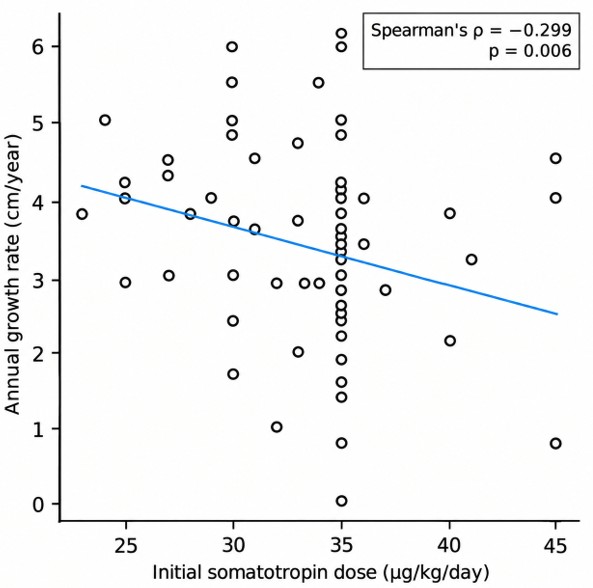
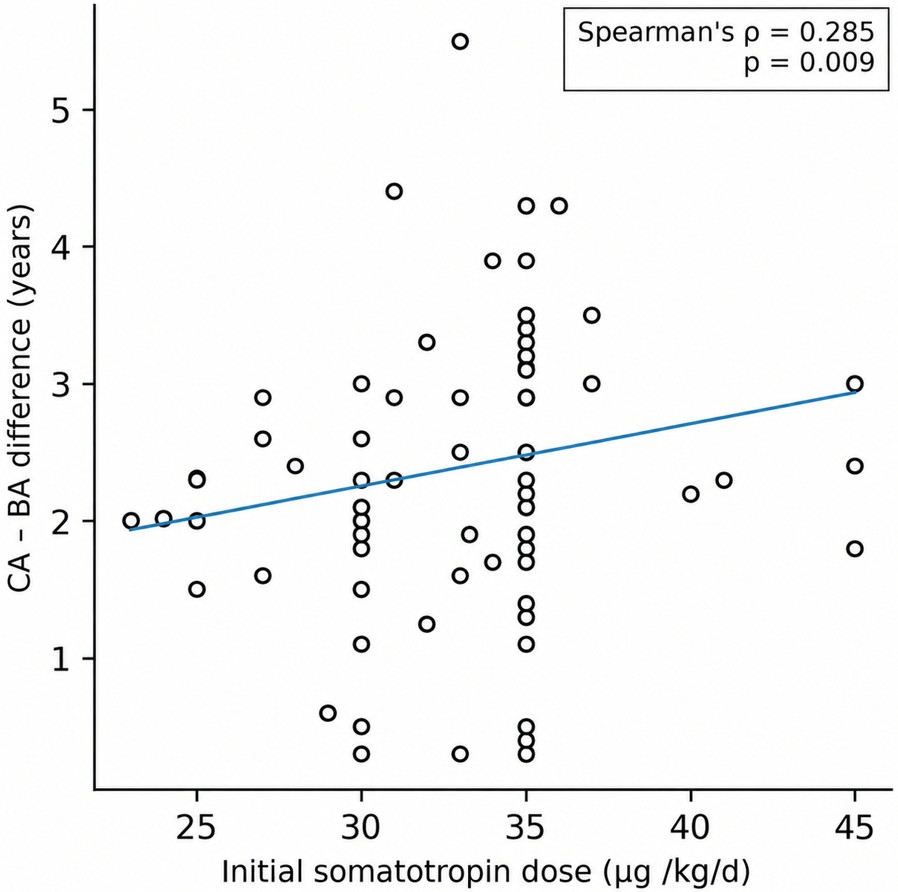
In correlation analyses, the initial somatropin dose showed a negative correlation with pre-treatment annual growth rate (Spearman’s ρ = −0.299, p=0.006) and a positive correlation with the difference between CA and BA (Spearman’s ρ = 0.285, p=0.009) (Figure 1 and Figure 2).
To identify variables independently associated with the initial GH dose, a multiple linear regression analysis was performed including age, pubertal status, annual growth rate, target height SDS, BA delay (CA−BA difference), and peak GH concentration. Lower pre-treatment annual growth rate remained independently associated with a higher initial GH dose (B = -0.86, 95% CI: -1.63 to -0.10, p=0.028), whereas target height SDS, BA delay, pubertal status, age, and peak GH concentration were not independently associated with the initial dose (Table 2).
| Model statistics: R2 = 0.166; adjusted R2 = 0.087. The multivariable analysis included patients with complete data for all variables entered into the regression model (complete-case analysis, n = 70). BA: bone age, CA: chronological age, CI: confidence interval, GH: growth hormone, SDS: standard deviation score. | ||
| Table 2. Multiple linear regression analysis of factors independently associated with the initial growth hormone dose. | ||
| Variable |
|
|
| Age (years) |
|
|
| Pubertal status |
|
|
| Target height SDS |
|
|
| Annual growth rate (cm/year) |
|
|
| Bone age delay (CA−BA, years) |
|
|
| Peak GH level (ng/mL) |
|
|
DISCUSSION
The principal finding of this study is that lower pre-treatment annual growth rate was the only variable independently associated with the prescribed initial GH dose after adjustment for potential confounders. Although lower target height SDS and greater BA delay were associated with higher prescribed doses in the univariate analyses, these associations were no longer statistically significant in the multivariable model.
Several studies have investigated predictors of response to GH therapy, focusing primarily on treatment outcomes rather than treatment initiation strategies. Large registry-based analyses and prediction models have consistently identified auxological parameters as key determinants of growth response during the first year of therapy and beyond. However, such studies typically compared predefined dosing regimens or assessed responsiveness to GH rather than examining how these variables influence initial dose selection.13 The guidelines provide a dose range for GH treatment according to the indication, but do not clearly emphasize which factors should be taken into consideration in dose selection.14,15 Current recommendations are based on weight-based dosing within a relatively narrow range for GH deficiency and emphasize individualization based on growth response.16 In addition, previous guidelines acknowledged the importance of familial height expectations in the evaluation of short stature; however, they provided limited guidance on how target height influenced GH dosing decisions.2,15 In a cohort study, higher somatropin doses were independently associated with better final height, together with mid-parental height, underscoring the importance of both genetic potential and adequate dosing in height prognosis.17 In the univariate analyses of our study, children with lower target height SDS, lower pre-treatment growth velocity, and greater BA delay were more likely to receive higher initial GH doses. However, after adjustment for other clinical variables, only pre-treatment annual growth rate remained independently associated with the prescribed dose. This practice is consistent with the literature data demonstrating a dose-response relationship between GH dose and both short-term growth velocity and final height in GH deficiency.18 However, because of the retrospective observational design, the present study cannot determine the actual decision-making process or establish causality. In addition, the inverse association between the initial GH dose and pre-treatment growth velocity should be interpreted with caution. This finding is likely influenced by confounding by indication, a common limitation of observational treatment studies, whereby children with more severe growth impairment are preferentially prescribed higher GH doses. Although higher GH doses may be considered during puberty because of increased physiological GH requirements and accelerated growth, pubertal status was not associated with clinicians’ initial dose selection in our cohort.
Recent guidelines have stated that the daily GH dose in children should be calculated on the basis of weight or body surface area and not titrated primarily on IGF-1 levels.16 Although evidence regarding factors influencing initial GH dose selection is limited in children, an adult study similarly reported that baseline IGF-1 levels had little influence on initial dose selection.14 While long-acting GH development studies use IGF-1 dynamics to define dose bands, routine clinical practice for daily somatropin appears to rely more on auxologic parameters and BA than on baseline biochemical severity.19 We showed that basal IGF-1 and IGFBP-3 levels did not influence initial dose in our cohort. In addition, despite being central to the diagnosis of GH deficiency, peak GH responses were not associated with the prescribed starting dose. Our findings therefore highlight a gap between the large amount of effort invested in biochemical characterization and its limited role in initial dose decisions for daily GH treatment in clinical practice. The lack of association between peak GH and starting dose also reflects the poor correlation between pharmacological test results and subsequent growth response, which was reported in prior studies and acknowledged in guidelines.16 Moreover, GH stimulation tests are known to have considerable intra-individual variability and limited reproducibility, which may reduce their value in guiding dose selection beyond establishing the diagnosis of GH deficiency.12 These findings suggest that, in routine clinical practice, clinicians may place greater emphasis on the overall clinical phenotype and auxological severity than on the biochemical severity of GH deficiency when selecting the initial dose within the recommended therapeutic range.
A greater CA−BA difference usually reflects greater growth potential and a larger window for catch-up growth.20 The association between greater BA delay and higher prescribed doses observed in the univariate analyses is clinically plausible, as clinicians may perceive delayed skeletal maturation as a marker of greater auxological severity. However, this association was no longer significant after adjustment for other clinical variables, suggesting that BA delay alone was not an independent determinant of dose selection. Although the absolute difference between chronological age and BA was significantly greater in the higher-dose group, the BA/CA ratio was comparable between groups. These findings are not contradictory because the two indices reflect different aspects of skeletal maturation. The CA−BA difference represents the absolute delay in skeletal maturation expressed in years, whereas the BA/CA ratio reflects the relative delay after accounting for chronological age. Consequently, children of different chronological ages may have similar BA/CA ratios despite different absolute BA delays. Together, our findings suggest that clinicians primarily rely on auxological assessment, particularly impaired pre-treatment growth velocity, when selecting the initial GH dose within the guideline-recommended range, rather than biochemical indices. This approach is consistent with the principle emphasized in international consensus statements that GH treatment should be individualized to optimize growth outcomes while avoiding unnecessary overtreatment.12,15 However, future prospective studies should examine whether formalized dosing algorithms based on baseline height deficit, target height, growth velocity, and the CA−BA difference can optimize both growth outcomes and safety, preferably integrating long-term data from cohorts treated with both daily and long-acting GH formulations.21-23 Although target height SDS and BA delay were associated with the initial GH dose in the univariate analyses, these associations were no longer statistically significant after adjustment for other clinical variables. In contrast, lower pre-treatment annual growth rate remained independently associated with higher prescribed doses, suggesting that clinicians may place particular emphasis on impaired growth velocity when selecting the initial GH dose.
This study has several limitations. The retrospective design limits causal inference and reflects clinician-driven decision-making rather than standardized dosing protocols. However, this also represents a strength, as it provides insight into real-world clinical practice, which may differ from controlled trial settings. In addition, our cohort consisted exclusively of children with isolated GH deficiency, improving internal consistency but limiting generalizability to patients with syndromic short stature or multiple pituitary hormone deficiencies. In addition, we did not assess early growth response or long-term outcomes such as near-adult height in relation to the initial dose, so it remains unknown whether the observed dose selection patterns translate into clinically meaningful differences in growth or metabolic endpoints. Despite these limitations, the study offers novel insight into how pediatric endocrinologists manage “individualized dosing” when initiating somatropin in children with isolated GH deficiency.
In conclusion, the principal finding of this study is that lower pre-treatment annual growth rate was the only factor independently associated with the initial GH dose after adjustment for potential confounders. Although lower target height SDS and greater BA delay were associated with higher prescribed doses in the univariate analyses, these associations were not independently maintained. Our findings suggest that, in routine clinical practice, clinicians place greater emphasis on impaired pre-treatment growth velocity than on biochemical indices when individualizing the initial GH dose in children with isolated GH deficiency. These results provide novel real-world evidence regarding prescribing patterns and may contribute to the optimization of individualized GH treatment strategies.
Ethical approval
This study was approved by the İzmir Dr Behcet Uz Children’s Hospital Ethics Committee (Date: 20.03.2025, Decision/Protocol No: 2025/06-02). Informed consent was obtained from all participants involved in this study.
Data availability statement
The data that support the findings of this study are available from the corresponding author upon reasonable request.
Conflict of interest
The authors declare that this study was conducted in the absence of any commercial or financial relationships that could be construed as a potential conflict of interest.
Funding
The authors declare that this study received no funding.
Generative AI statement
The authors declare that no generative AI or AI-assisted technologies were used in the writing or preparation of this study.
References
- Kim JH, Chae HW, Chin SO, et al. Diagnosis and treatment of growth hormone deficiency: a position statement from Korean Endocrine Society and Korean Society of Pediatric Endocrinology. Endocrinol Metab (Seoul). 2020;35:272-87. https://doi.org/10.3803/EnM.2020.35.2.272
- Grimberg A, DiVall SA, Polychronakos C, et al. Guidelines for growth hormone and insulin-like growth factor-i treatment in children and adolescents: growth hormone deficiency, idiopathic short stature, and primary insulin-like growth factor-i deficiency. Horm Res Paediatr. 2016;86:361-97. https://doi.org/10.1159/000452150
- Lee KW, Cohen P. Individualized growth hormone therapy in children: advances beyond weight-based dosing. J Pediatr Endocrinol Metab. 2003;16 Suppl 3:625-30.
- Ranke MB, Schweizer R, Wollmann HA, Schwarze P. Dosing of growth hormone in growth hormone deficiency. Horm Res. 1999;51:70-4. https://doi.org/10.1159/000053165
- Lee KW, Cohen P. Individualizing growth hormone dosing in children. Horm Res. 2001;56:29-34. https://doi.org/10.1159/000048131
- Neyzi O, Bundak R, Gökçay G, et al. Reference values for weight, height, head circumference, and body mass index in Turkish children. J Clin Res Pediatr Endocrinol. 2015;7:280-93. https://doi.org/10.4274/jcrpe.2183
- Marshall WA, Tanner JM. Variations in pattern of pubertal changes in girls. Arch Dis Child. 1969;44:291-303. https://doi.org/10.1136/adc.44.235.291
- Marshall WA, Tanner JM. Variations in the pattern of pubertal changes in boys. Arch Dis Child. 1970;45:13-23. https://doi.org/10.1136/adc.45.239.13
- Tanner JM. Normal growth and techniques of growth assessment. Clin Endocrinol Metab. 1986;15:411-51. https://doi.org/10.1016/s0300-595x(86)80005-6
- Greulich WW, Pyle SI. Radiographic atlas of skeletal development of the hand and wrist. 2nd ed. Stanford University Press; 1959.
- Guven B, Can M, Mungan G, Acіkgoz S. Reference values for serum levels of insulin-like growth factor 1 (IGF-1) and IGF-binding protein 3 (IGFBP-3) in the West Black Sea region of Turkey. Scand J Clin Lab Invest. 2013;73:135-40. https://doi.org/10.3109/00365513.2012.755739
- Growth Hormone Research Society. Consensus guidelines for the diagnosis and treatment of growth hormone (GH) deficiency in childhood and adolescence: summary statement of the GH Research Society. GH Research Society. J Clin Endocrinol Metab. 2000;85:3990-3. https://doi.org/10.1210/jcem.85.11.6984
- Ly HJ, Fors H, Nilsson S, Dahlgren J. A prediction model could foresee adequate height response in children eligible for growth hormone treatment. Acta Paediatr. 2022;111:346-53. https://doi.org/10.1111/apa.16070
- Cook DM, Yuen KCJ. Growth hormone dosing variables in growth hormone-deficient adults. Growth Horm IGF Res. 2006;16(Suppl A):S49-54. https://doi.org/10.1016/j.ghir.2006.03.007
- Cook DM, Rose SR. A review of guidelines for use of growth hormone in pediatric and transition patients. Pituitary. 2012;15:301-10. https://doi.org/10.1007/s11102-011-0372-6
- Tran K, Grobelna A. Somatropin for growth hormone deficiency. Can J Health Technol. 2023;3:1-47. https://doi.org/10.51731/cjht.2023.708
- Rivera-Hernández A, Sánchez-García F, Zurita-Cruz J, Balcázar-Hernández L. Somatropin and final height in Mexican paediatric population with growth hormone deficiency. Andes Pediatr. 2022;93:496-503. https://doi.org/10.32641/andespediatr.v93i4.3763
- Dauber A, Phillip M, Ferran JM, et al. Clinical predictors of good/poor response to growth hormone treatment in children with idiopathic short stature. Horm Res Paediatr. 2026;99:448-60. https://doi.org/10.1159/000542579
- Peng H, Shang W, Lin Y, et al. Phase 1 study and population PK/PD modeling of long-acting growth hormone, GB08, to guide pediatric dosing. Eur J Endocrinol. 2025;193:117-28. https://doi.org/10.1093/ejendo/lvaf131
- Moon JE, Ko CW. Delayed bone age might accelerate the response to human growth hormone treatment in small for gestational age children with short stature. Int J Endocrinol. 2019;2019:8454303. https://doi.org/10.1155/2019/8454303
- Awad MH, Ghanim R, Eladl R, Mughal Z, Mustafa M. Real-world efficacy of weekly somatrogon on growth and bone health in pediatric growth hormone deficiency: a 12-month retrospective cohort study. J Clin Res Pediatr Endocrinol. 2026;18:254-60. https://doi.org/10.4274/jcrpe.galenos.2025.2025-6-24
- Maniatis AK, Thornton PS, Nadgir UM, et al. Children with growth hormone deficiency treated with lonapegsomatropin demonstrated sustained height improvements for up to 6 years: enliGHten trial final results. Horm Res Paediatr. 2026;99:705-717. https://doi.org/10.1159/000545064
- Zadik Z, Zelinska N, Iotova V, et al. An open-label extension of a phase 2 dose-finding study of once-weekly somatrogon vs. once-daily Genotropin in children with short stature due to growth hormone deficiency: results following 5 years of treatment. J Pediatr Endocrinol Metab. 2023;36:261-69. https://doi.org/10.1515/jpem-2022-0359
Copyright and license
Copyright © 2026 The author(s). This is an open-access article published by Aydın Pediatric Society under the terms of the Creative Commons Attribution License (CC BY) which permits unrestricted use, distribution, and reproduction in any medium or format, provided the original work is properly cited.