


Abstract
Objective: To compare first-year biochemical and auxological outcomes of monthly 3.75 mg and 3-monthly 11.25 mg depot leuprolide acetate (dLA) treatment in girls with central precocious puberty (CPP) and to evaluate factors associated with biochemical non-suppression and first-year growth velocity.
Methods: This single-center prospective quasi-randomized comparative study included 87 girls with CPP treated with dLA for 12 months. Patients received either monthly 3.75 mg (n=46) or 3-monthly 11.25 mg dLA treatment (n=41). Auxological parameters, gonadotropin-releasing hormone (GnRH)-stimulated luteinizing hormone (LH) responses, and LH levels measured 40 minutes after dLA injection (40-minute post-dLA LH) were evaluated. Biochemical non-suppression was defined as a year-one 40-minute post-dLA LH level >3.07 IU/L. Logistic regression was used to identify predictors of biochemical non-suppression, and linear regression was performed to determine factors associated with first-year annual growth velocity.
Results: One year after initiation of treatment, there was no difference in annual growth velocity (5.73 ± 1.01 vs 5.81 ± 0.92 cm/year, p=0.956), bone age, Δbone age, and other auxological and pelvic ultrasonographic parameters between treatment groups. Year-one biochemical suppression was achieved in 33/46 patients (71.7%) in the 3.75 mg group and 33/41 patients (80.5%) in the 11.25 mg group, with no significant between-group difference (p=0.450). Biochemical non-suppression was associated with higher annual growth velocity and higher pretreatment GnRH-stimulated peak LH; in logistic regression analysis, pretreatment GnRH-stimulated peak LH was the only independent predictor of biochemical non-suppression (adjusted OR 1.04, 95% CI 1.01–1.07, p=0.012). First-year annual growth velocity correlated with 6-month GnRH-stimulated peak LH (r=0.320, p=0.003), 6-month 40-minute post-dLA LH (r=0.339, p=0.001), year-one basal LH (r=0.314, p=0.003), and year-one 40-minute post-dLA LH (r=0.517, p<0.001). In multivariable analysis, year-one 40-minute post-dLA LH remained independently associated with annual growth velocity (B=0.39, 95% CI 0.26–0.52, p<0.001), whereas other parameters did not.
Conclusions: Monthly 3.75 mg and 3-monthly 11.25 mg depot leuprolide acetate provided comparable first-year auxological outcomes. Higher pretreatment GnRH-stimulated peak LH predicted biochemical non-suppression, whereas year-one 40-minute post-dLA LH level was independently associated with first-year growth velocity, suggesting that it may represent a more robust parameter for monitoring residual pubertal activity during treatment.
Keywords: puberty, precocious, gonadotropin-releasing hormone, luteinizing hormone, treatment outcome, leuprolide
INTRODUCTION
Central precocious puberty (CPP) is characterized by premature activation of the hypothalamic–pituitary–gonadal axis, resulting in progressive pubertal development before 8 years of age in girls. Accelerated growth and advanced skeletal maturation may compromise adult height if treatment is not initiated in appropriate patients. The main goals of therapy are to suppress pubertal progression, normalize growth velocity, slow bone age advancement, and preserve height potential.1 Gonadotropin-releasing hormone (GnRH) agonists (GnRHa) are the standard treatment for CPP. Depot leuprolide acetate (dLA) is available as monthly 3.75 mg and 3-monthly 11.25 mg formulations, and previous studies have reported broadly comparable biochemical and auxological efficacy between these regimens. The 3-monthly formulation may also reduce injection burden during long-term treatment.2-5
Monitoring treatment adequacy during GnRHa therapy remains challenging. Although basal or random luteinizing hormone (LH) measurements are practical, elevated pre-injection or random LH levels may occur despite adequate clinical suppression, limiting their reliability as isolated markers of treatment adequacy.6-8 GnRH-stimulated LH testing has traditionally been used to assess biochemical suppression during treatment; however, it requires venous access and repeated sampling, limiting its practicality for routine follow-up. Post-dLA LH sampling has therefore been proposed as a practical dynamic alternative that assesses the acute gonadotropin response to the therapeutic agonist.9,10
Building on our previously identified 40-minute post-dLA LH threshold for monitoring pubertal suppression11, this study compared first-year biochemical and auxological outcomes of monthly 3.75 mg and 3-monthly 11.25 mg dLA treatment in girls with CPP. We also evaluated factors associated with year-one biochemical non-suppression and first-year annual growth velocity, with particular emphasis on the year-one 40-minute post-dLA LH response.
MATERIALS AND METHODS
Study design and patients
This single-center prospective quasi-randomized comparative study was conducted between 2022 and 2025 in a tertiary pediatric endocrinology clinic. Patients were allocated in a 1:1 ratio to receive either monthly dLA 3.75 mg or 3-monthly dLA 11.25 mg according to a predefined alternating sequence. Treatment allocation was implemented by the principal investigator without allocation concealment.
No a priori sample size calculation was performed. All eligible patients who met the inclusion criteria and provided consent during the predefined study period were enrolled prospectively. A total of 91 patients were allocated to the two treatment groups evaluated in the present study: 46 patients to the monthly 3.75 mg group and 45 patients to the 3-monthly 11.25 mg group. Of the four patients excluded from the 3-monthly 11.25 mg group, one moved to another city, and three did not attend scheduled follow-up visits regularly. We calculated scheduled dates for dLA administration and hormonal testing in advance, and the same experienced pediatric endocrinology nurse performed all injections, blood sampling, and stimulation tests. No procurement or administration problems were documented. Therefore, the final analysis included 87 girls who completed 12 months of follow-up and had complete first-year auxological and hormonal data: 46 patients in the monthly 3.75 mg group and 41 patients in the 3-monthly 11.25 mg group. The analyses were therefore performed according to the per-protocol principle. Patient flow is shown in Figure 1.
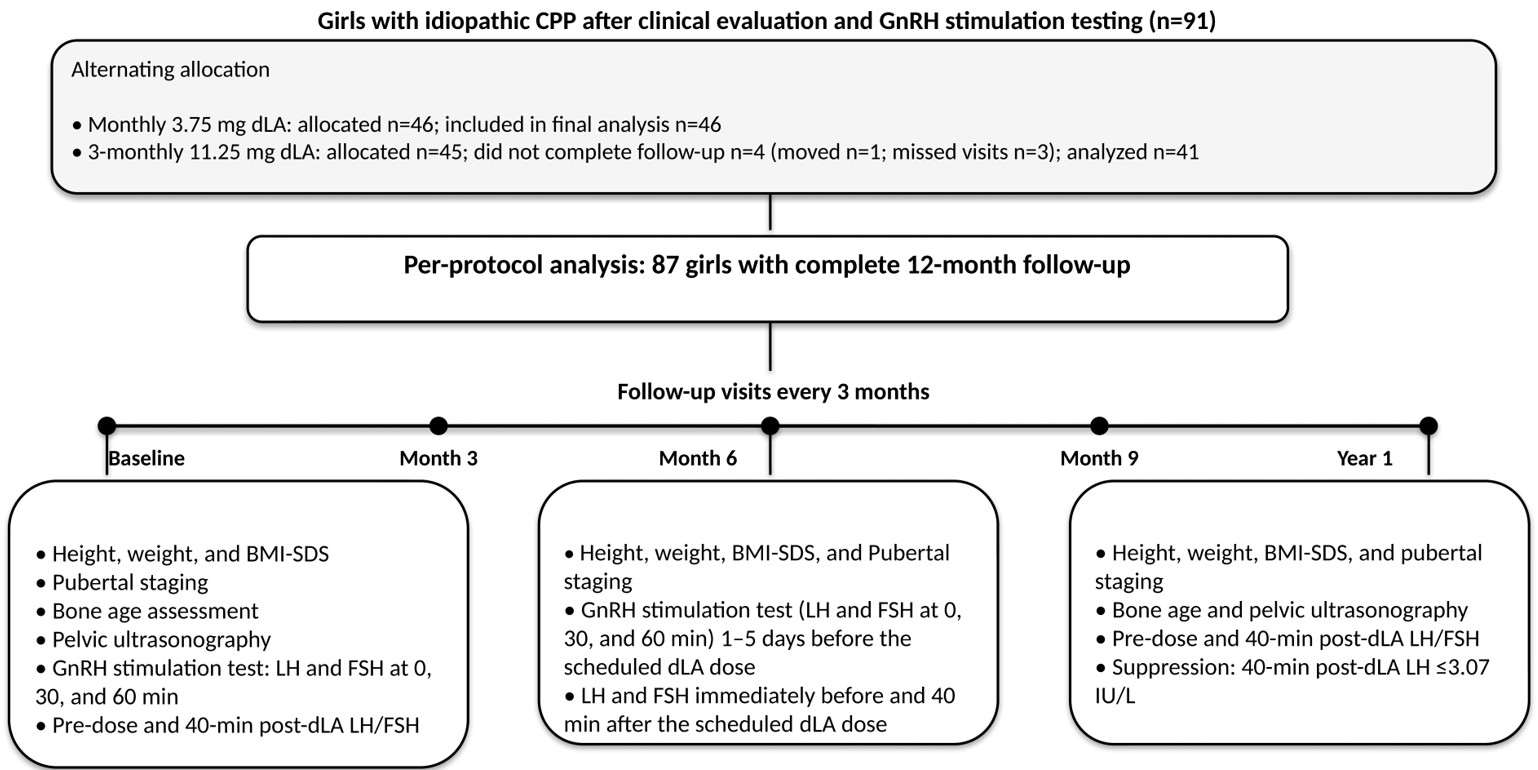
CPP was diagnosed according to established criteria: onset of breast development before 8 years of age, accelerated growth velocity and/or advanced bone age, and a pubertal LH response to GnRH stimulation (peak LH ≥5 IU/L).1 Exclusion criteria were peripheral precocious puberty, organic CPP, any chronic systemic disease affecting growth, and incomplete 12-month follow-up data.
Auxological and pubertal assessments
Clinical follow-up visits were scheduled at 3-month intervals throughout the first treatment year. At baseline and at each follow-up visit, height, weight, and body mass index (BMI) were measured and expressed as standard deviation scores (SDS) according to national reference data.12 Pubertal stage was assessed according to Tanner criteria.13 Bone age was evaluated from left hand and wrist radiographs using the Greulich and Pyle method14, and the bone age/chronological age (BA/CA) ratio and bone age advancement (BA–CA) were calculated. Change in bone age (ΔBA) was calculated as year-one bone age minus baseline bone age. Annualized growth velocity during the first 6 months was calculated from baseline and 6-month height measurements, whereas first-year annual growth velocity was calculated from baseline and 12-month height measurements. Standing height was measured using a calibrated Harpenden stadiometer (Holtain Ltd., Crymych, UK) and recorded to the nearest 0.1 cm. Pelvic ultrasonography was performed at baseline and at year 1 as part of routine clinical assessment.
Hormonal assessments
All blood samples were collected in the morning between 08:00 and 08:30. At baseline, the GnRH stimulation test was performed after insertion of an intravenous cannula. Blood samples were obtained for basal LH and follicle-stimulating hormone (FSH), followed by intravenous administration of gonadorelin acetate at 2.5 μg/kg, up to a maximum dose of 100 μg. Blood samples for LH and FSH were then collected at 30 and 60 minutes, and peak LH was recorded. At treatment initiation, serum LH and FSH were measured immediately before the first dLA injection and 40 minutes after injection. At month 6, a standard GnRH stimulation test was performed 1–5 days before the scheduled dLA dose. On the day of the scheduled dLA injection, LH and FSH were again measured immediately before and 40 minutes after dLA administration. The same pre-injection and 40-minute post-dLA sampling protocol was repeated at the year-one dose visit. All hormonal samples were analyzed on the day of collection and were not stored for subsequent batch analysis. Serum LH, FSH, and estradiol were measured using a chemiluminescent immunoassay system (Beckman Coulter Diagnostics, CA, USA) according to the manufacturer’s protocol. The minimum detectable concentration was 0.07 IU/L for both LH and FSH.
Definition of biochemical suppression
At 6 months, biochemical suppression was assessed using the standard GnRH stimulation test and was defined as a GnRH-stimulated peak LH level <3 IU/L, consistent with previous CPP treatment studies.15-17 Six-month GnRH-stimulated peak LH and 6-month 40-minute post-dLA LH levels were also evaluated as on-treatment hormonal parameters. As a repeat GnRH stimulation test was not included in the year-one protocol, year-one biochemical suppression was assessed using the previously validated 40-minute post-dLA LH threshold. Year-one biochemical suppression was defined as a year-one 40-minute post-dLA LH level of ≤3.07 IU/L, and biochemical non-suppression was defined as a level >3.07 IU/L. This threshold was derived from our group’s previously published receiver operating characteristic (ROC) analysis in a prospective cohort of girls with CPP, in which a 40-minute post-dLA LH level of 3.07 IU/L optimally discriminated between GnRH-stimulated suppressed and non-suppressed patients, with an area under the curve (AUC) of 0.83, sensitivity of 80.8%, and specificity of 75.5%.11
Statistical analysis
The normality of continuous variables was assessed using the Shapiro–Wilk test. Continuous variables are presented as mean ± standard deviation or median (25th–75th percentiles), as appropriate. Categorical variables are presented as number and percentage. Between-group comparisons were performed using the independent-samples t-test or Mann–Whitney U test for continuous variables and the chi-square or Fisher’s exact test for categorical variables. We calculated the magnitude of decline in growth velocity for each patient by subtracting the first-year annual growth velocity from the 6-month annualized growth velocity and compared it between treatment groups using an independent-samples t-test. We evaluated within-group changes in growth velocity between 6 months and year one using a paired-samples t-test. We used Pearson or Spearman correlation analyses to assess associations between LH parameters and annual growth velocity. A multivariable logistic regression model including treatment regimen and pretreatment GnRH-stimulated peak LH was used to evaluate factors associated with year-one biochemical non-suppression; adjusted odds ratios (OR) with 95% confidence intervals (CI) are reported. A multivariable linear regression model including treatment regimen, age at treatment initiation, pretreatment GnRH-stimulated peak LH, and year-one 40-minute post-dLA LH was used to evaluate factors associated with annual growth velocity. Variables were selected based on clinical relevance and their associations with the outcomes, while correlated on-treatment LH measurements were not included simultaneously. All analyses were performed using GraphPad Prism version 10.0 (GraphPad Software, Boston, MA, USA). A two-sided p-value < 0.05 was considered statistically significant.
Ethical approval
The study was approved by the institutional Ethics Committee, approval number 09.2022.486, and conducted in accordance with the Declaration of Helsinki. Written informed consent was obtained from parents or legal guardians of all participants, and patient assent was obtained where appropriate.
RESULTS
At treatment initiation, 87 girls with CPP were included in the baseline comparison: 46 patients received monthly dLA 3.75 mg and 41 patients received 3-monthly dLA 11.25 mg. Chronological age was higher in the monthly 3.75 mg group than in the 3-monthly 11.25 mg group (8.27 ± 0.60 vs 7.86 ± 0.94 years, p=0.014), whereas bone age and the BA/CA ratio did not differ significantly between groups (p=0.065 and p=0.961, respectively).
Baseline anthropometric parameters, basal and GnRH-stimulated gonadotropin responses, LH/FSH ratios, and pelvic ultrasonographic findings were comparable between groups, except for uterine length and pre-stimulation basal FSH during the pretreatment GnRH test, both of which were higher in the monthly 3.75 mg group (both p=0.046) (Table 1). At year one, annual growth velocity was comparable between the monthly 3.75 mg and 3-monthly 11.25 mg groups (5.73 ± 1.01 vs 5.81 ± 0.92 cm/year, p=0.956). Other first-year auxological and pelvic ultrasonographic outcomes, including height SDS, BMI-SDS, bone age, BA/CA ratio, BA advancement, uterine measurements, and ovarian volumes, were also similar between treatment regimens. The year-one 40-minute post-dLA LH level did not differ significantly between groups, whereas basal LH, basal FSH, basal LH/FSH ratio, 40-minute FSH, and 40-minute LH/FSH ratio differed between groups (Table 2). In the 3-monthly 11.25 mg group, growth velocity decreased from 8.03 ± 2.12 to 5.81 ± 0.92 cm/year, and in the monthly 3.75 mg group, it decreased from 8.09 ± 2.08 to 5.73 ± 1.01 cm/year (both p<0.001). The magnitude of decline in growth velocity was 2.36 ± 2.14 cm/year in the monthly 3.75 mg group and 2.22 ± 2.24 cm/year in the 3-monthly 11.25 mg group, with no significant between-group difference (mean difference, 0.14 cm/year; 95% CI, −0.80 to 1.08; p=0.767). At the year-one dose visit, using the predefined 40-minute post-dLA LH threshold, biochemical suppression was achieved in 33/46 patients (71.7%) in the monthly 3.75 mg group and 33/41 patients (80.5%) in the 3-monthly 11.25 mg group, with no significant between-group difference (p=0.450). Patients with year-one biochemical non-suppression and those with suppression were comparable in age at treatment initiation, BA/CA ratio, and BMI-SDS (all p>0.05). Pretreatment GnRH-stimulated peak LH was significantly higher in the non-suppressed group than in the suppressed group (15.60 [9.27–25.00] vs 8.91 [6.54–14.84] IU/L, p=0.004). In addition, both 6-month GnRH-stimulated peak LH and 6-month 40-minute post-dLA LH were higher in patients with year-one biochemical non-suppression than in those with suppression (2.82 [2.09–4.04] vs 1.63 [1.18–2.22] IU/L and 4.04 [3.11–5.27] vs 2.33 [1.85–2.83] IU/L, respectively; both p<0.001). Patients with biochemical non-suppression also had higher annual growth velocity than those with suppression (6.45 [6.00–6.95] vs 5.50 [4.94–5.90] cm/year, p<0.001), whereas ΔBA was similar between groups (p=0.510) (Table 3). A multivariable logistic regression model including treatment regimen and pretreatment GnRH-stimulated peak LH was constructed. Pretreatment GnRH-stimulated peak LH remained independently associated with biochemical non-suppression (adjusted OR 1.04, 95% CI 1.01–1.07, p=0.012), whereas treatment regimen was not independently associated with this outcome (Table 4). First-year annual growth velocity was positively correlated with both 6-month GnRH-stimulated peak LH (r=0.320, p=0.003) and 6-month 40-minute post-dLA LH (r=0.339, p=0.001). Year-one basal LH was also positively correlated with annual growth velocity (r=0.314, p=0.003); however, the strongest correlation was observed with year-one 40-minute post-dLA LH (r=0.517, p<0.001) (Table 5). In the multivariable linear regression model, year-one 40-minute post-dLA LH remained independently associated with annual growth velocity after adjustment for treatment regimen, age at treatment initiation, and pretreatment GnRH-stimulated peak LH (B=0.39, 95% CI 0.26–0.52, p<0.001) (Table 6).
| Values are presented as mean±SD or median (25th–75th percentiles), according to data distribution. BA, bone age; BMI, body mass index; CA, chronological age; dLA, depot leuprolide acetate; FSH, follicle-stimulating hormone; GnRH, gonadotropin-releasing hormone; LH, luteinizing hormone; SD, standard deviation; SDS, standard deviation score. | |||
| Table 1. Pretreatment clinical, auxological, ultrasonographic, and hormonal characteristics by treatment regimen. | |||
|
|
|
|
|
| Age, years |
|
|
|
| Bone age, years |
|
|
|
| BA/CA ratio |
|
|
|
| Height SDS |
|
|
|
| Weight SDS |
|
|
|
| BMI SDS |
|
|
|
| Basal LH, IU/L |
|
|
|
| Basal FSH, IU/L |
|
|
|
| Uterine length, mm |
|
|
|
| Uterine volume, cm3 |
|
|
|
| Left ovarian volume, cm3 |
|
|
|
| Right ovarian volume, cm3 |
|
|
|
| Basal LH during GnRH test, IU/L |
|
|
|
| Peak LH during pretreatment GnRH test, IU/L |
|
|
|
| Basal FSH during GnRH test, IU/L |
|
|
|
| Peak FSH during pretreatment GnRH test, IU/L |
|
|
|
| Peak LH/FSH ratio during GnRH test |
|
|
|
| Values are presented as mean±SD. BA, bone age; BMI-SDS, body mass index standard deviation score; CA, chronological age; dLA, depot leuprolide acetate; FSH, follicle-stimulating hormone; LH, luteinizing hormone; SD, standard deviation; SDS, standard deviation score. | |||
| Table 2. Year-one auxological, ultrasonographic, and hormonal outcomes by treatment regimen. | |||
|
|
|
|
|
| Height SDS |
|
|
|
| Weight SDS |
|
|
|
| BMI-SDS |
|
|
|
| Bone age (BA), years |
|
|
|
| BA/CA ratio |
|
|
|
| BA advancement (BA–CA), years |
|
|
|
| Uterine length, mm |
|
|
|
| Uterine volume, cm3 |
|
|
|
| Left ovarian volume, cm3 |
|
|
|
| Right ovarian volume, cm3 |
|
|
|
| Annual growth velocity, cm/year |
|
|
|
| Hormonal outcomes at year one | |||
| Basal LH, IU/L |
|
|
|
| Basal FSH, IU/L |
|
|
|
| Basal LH/FSH ratio |
|
|
|
| 40-minute post-dLA LH, IU/L |
|
|
|
| 40-minute post-dLA FSH, IU/L |
|
|
|
| 40-minute post-dLA LH/FSH ratio |
|
|
|
| Values are presented as median (25th–75th percentiles). BA, bone age; BMI-SDS, body mass index standard deviation score; dLA, depot leuprolide acetate; GnRH, gonadotropin-releasing hormone; GV, growth velocity; LH, luteinizing hormone. Biochemical non-suppression was defined as a year-one 40-minute post-dLA LH level >3.07 IU/L, and suppression as ≤3.07 IU/L. | |||
| Table 3. Clinical and hormonal parameters according to year-one biochemical suppression status. | |||
|
|
|
|
|
| Age, years |
|
|
|
| BA/CA ratio |
|
|
|
| BMI-SDS |
|
|
|
| Pretreatment GnRH-stimulated peak LH, IU/L |
|
|
|
| 6-month GnRH-stimulated peak LH, IU/L |
|
|
|
| 6-month 40-minute post-dLA LH, IU/L |
|
|
|
| ΔBA, years |
|
|
|
| Annual GV, cm/year |
|
|
|
| Year-one biochemical non-suppression was defined as a year-one 40-minute post-dLA LH level >3.07 IU/L. Model fit: omnibus likelihood-ratio χ2(2)=8.32, p=0.016; Nagelkerke R2=0.136; Hosmer–Lemeshow χ2(8)=1.17, p=0.997. The maximum variance inflation factor was 1.00. CI, confidence interval; dLA, depot leuprolide acetate; GnRH, gonadotropin-releasing hormone; LH, luteinizing hormone; OR, odds ratio. | ||
| Table 4. Baseline predictors of year-one biochemical non-suppression. | ||
|
|
|
|
| Treatment regimen, 11.25 mg vs 3.75 mg |
|
|
| Pretreatment GnRH-stimulated peak LH, IU/L |
|
|
| dLA, depot leuprolide acetate; GnRH, gonadotropin-releasing hormone; LH, luteinizing hormone. | ||
| Table 5. Correlations between LH parameters and annual growth velocity during the first year of treatment. | ||
| Variable |
|
|
| Pretreatment GnRH-stimulated peak LH |
|
|
| 6-month GnRH-stimulated peak LH |
|
|
| 6-month 40-minute post-dLA LH |
|
|
| Year-one basal LH |
|
|
| Year-one 40-minute post-dLA LH |
|
|
| Model fit: R2=0.304; adjusted R2=0.270; F(4,82)=8.95, p<0.001. B coefficients are unstandardized regression coefficients. The maximum variance inflation factor was 1.31. B, unstandardized regression coefficient; CI, confidence interval; dLA, depot leuprolide acetate; GnRH, gonadotropin-releasing hormone; LH, luteinizing hormone. | |||
| Table 6. Factors associated with first-year annual growth velocity. | |||
| Variable |
|
|
|
| Treatment regimen |
|
|
|
| Age at treatment initiation |
|
|
|
| Pretreatment GnRH-stimulated peak LH |
|
|
|
| Year-one 40-minute post-dLA LH |
|
|
|
DISCUSSION
In this prospective quasi-randomized comparative study of girls with CPP treated with depot leuprolide acetate for 12 months, monthly 3.75 mg and 3-monthly 11.25 mg regimens provided comparable first-year auxological outcomes, with a numerically higher biochemical suppression rate in the 3-monthly regimen. Annual growth velocity, height SDS, BMI-SDS, bone age parameters, and pelvic ultrasonographic findings were similar between groups, and growth velocity declined significantly from 6 months to year one in both regimens. These findings support effective first-year auxological control in the majority of patients with both formulations and are consistent with previous studies reporting comparable clinical efficacy of monthly and longer-acting leuprolide acetate regimens in CPP.3-5
Beyond regimen comparison, pretreatment GnRH-stimulated peak LH independently predicted year-one biochemical non-suppression in our cohort. Previous studies have evaluated basal, pre-injection, and stimulated LH measurements as biochemical monitoring tools during GnRHa treatment; however, isolated LH elevations do not always correspond to clinical pubertal progression or unfavorable auxological outcomes.6,18-20 Although the specific relationship between pretreatment GnRH-stimulated peak LH and subsequent biochemical non-suppression has not been extensively investigated, our finding suggests that greater hypothalamic–pituitary–gonadal axis activation before treatment may be associated with a higher likelihood of incomplete biochemical suppression during follow-up. This finding requires confirmation in independent cohorts. Previous studies have also demonstrated that a single post-leuprolide LH measurement may provide a practical assessment of biochemical suppression, primarily based on its agreement with stimulated LH criteria.9,10 Nevertheless, biochemical LH measurements have not consistently correlated with clinical or growth-related outcomes and should therefore be interpreted together with clinical and auxological parameters.21 In the present study, year-one 40-minute post-dLA LH remained independently associated with concurrent annual growth velocity. To our knowledge, this specific association has not previously been reported.
Previous randomized and comparative studies have shown effective pubertal suppression with both monthly and 3-monthly leuprolide acetate formulations, although stimulated gonadotropin responses may differ according to regimen, sampling time, and suppression threshold.3-5,22 In a recent comparative study, 3-monthly leuprolide acetate was associated with greater hormonal suppression and lower growth velocity and bone age advancement; however, predicted adult height did not differ significantly between monthly and 3-monthly regimens.22 In our cohort, biochemical suppression rates and first-year auxological outcomes were comparable between regimens, despite slightly different hormonal responses. This supports the interpretation that hormonal differences should be evaluated together with growth velocity and skeletal maturation rather than as isolated endpoints.
Biochemical monitoring during GnRH agonist therapy remains challenging, because basal or random LH measurements are practical but may not reliably reflect clinically relevant residual gonadotropic activity during treatment.7,8,18 Although GnRH-stimulated LH levels are considered the gold standard for monitoring hormonal suppression during treatment, they require intravenous cannula insertion and repeated sampling, and are therefore cumbersome and invasive. We have recently demonstrated that 40-minute post-dLA LH levels show close agreement with GnRH-stimulated LH levels and can be used for both diagnostic assessment and treatment monitoring in girls with CPP.11 The physiological rationale for post-dose LH monitoring is supported by pharmacodynamic studies showing that LH rises shortly after depot leuprolide administration, creating a brief stimulatory window for post-injection assessment.23 Previous studies also suggested that single post-leuprolide LH measurements may be useful for evaluating gonadotropin suppression during GnRHa therapy.9,10 Building on this concept, our previous prospective study identified a 40-minute post-dLA LH threshold of 3.07 IU/L for treatment monitoring using GnRH-stimulated suppression as the reference standard.11 In the present study, year-one basal LH correlated with annual growth velocity, but this association was weaker than that observed for year-one 40-minute post-dLA LH and was no longer independent in multivariable analysis. By contrast, year-one 40-minute post-dLA LH remained independently associated with annual growth velocity. These findings suggest that the 40-minute post-dLA LH response is a better marker than basal LH for evaluating gonadotropic activity during dLA treatment.
Year-one biochemical non-suppression was not associated with treatment regimen, age at treatment initiation, BA/CA ratio, or baseline BMI-SDS. Patients with biochemical non-suppression had higher annual growth velocity than those with suppression, whereas bone-age advancement was comparable between groups. This dissociation may reflect the limited timeframe of first-year follow-up, as changes in growth velocity may precede detectable differences in skeletal maturation. Biochemical suppression is generally accompanied by regression or stabilization of clinical pubertal signs and reduced growth velocity; however, the relationship between the degree of LH suppression and the magnitude of the auxological response is not uniform across studies. In a cohort of 64 girls and seven boys treated with depot leuprolide, peak-stimulated and basal LH levels during treatment were not significantly associated with growth velocity, rate of skeletal maturation, or predicted adult stature24, whereas a separate series of 30 girls reported a significant correlation between lower pre-injection LH levels and greater improvement in predicted adult height.20 This discordance may reflect heterogeneity in cohort composition, assay methodology, and the timing of hormonal sampling relative to the injection interval. Regarding final adult height, long-term studies have primarily focused on clinical and auxological determinants rather than biochemical suppression status during the first treatment year.25,26 Consequently, direct evidence that the degree of first-year biochemical suppression predicts final adult height remains to be established. Thus, biochemical non-suppression defined by a laboratory threshold should be interpreted together with growth velocity, skeletal maturation, and clinical pubertal progression rather than as an isolated indicator of treatment failure. In the present study, year-one 40-minute post-dLA LH was independently associated with concurrent annual growth velocity after multivariable adjustment, suggesting potential auxological relevance. Whether this association translates into differences in predicted or final adult height requires prospective long-term follow-up.
This study has some limitations. No a priori sample size calculation was performed, the sample size was modest (particularly for subgroup analyses), and follow-up was limited to the first treatment year. Therefore, the long-term implications of year-one biochemical non-suppression for predicted adult height and final adult height could not be determined. In addition, the 3.07 IU/L threshold was derived from our previous cohort and requires external validation across different populations, assays, and GnRHa protocols. Furthermore, pelvic ultrasonography was performed by multiple radiologists, and inter-observer reliability was not assessed; therefore, measurement variability between observers cannot be excluded. Finally, despite quasi-randomized allocation, chronological age differed significantly between the treatment groups at baseline, whereas bone age was comparable. This baseline imbalance may have introduced residual confounding when interpreting between-group outcomes. Nevertheless, the prospective design, predefined follow-up protocol, and combined assessment of biochemical and auxological outcomes strengthen the clinical relevance of the findings.
In conclusion, monthly 3.75 mg and 3-monthly 11.25 mg depot leuprolide acetate provided comparable first-year auxological outcomes in girls with CPP. Pretreatment GnRH-stimulated peak LH independently predicted year-one biochemical non-suppression, whereas year-one 40-minute post-dLA LH was independently associated with first-year annual growth velocity. These findings suggest that the 40-minute post-dLA LH response may serve as an adjunctive marker of residual gonadotropic activity when interpreted together with growth velocity and other clinical indicators.
Ethical approval
This study was approved by the Marmara University Ethics Committee (Date: 29.04.2022, Decision/Protocol No: 09.2022.486). Informed consent was obtained from all participants involved in this study.
Data availability statement
The data that support the findings of this study are available from the corresponding author upon reasonable request.
Conflict of interest
The authors declare that this study was conducted in the absence of any commercial or financial relationships that could be construed as a potential conflict of interest.
Funding
The authors declare that this study received no funding.
Generative AI statement
The authors declare that no generative AI or AI-assisted technologies were used in the writing or preparation of this study.
References
- Latronico AC, Roberts SA, Alonzo M, et al. Central precocious puberty: an Endocrine Society clinical practice guideline. J Clin Endocrinol Metab. 2026;111:2101-44. https://doi.org/10.1210/clinem/dgag168
- Badaru A, Wilson DM, Bachrach LK, et al. Sequential comparisons of one-month and three-month depot leuprolide regimens in central precocious puberty. J Clin Endocrinol Metab. 2006;91:1862-7. https://doi.org/10.1210/jc.2005-1500
- Fuld K, Chi C, Neely EK. A randomized trial of 1- and 3-month depot leuprolide doses in the treatment of central precocious puberty. J Pediatr. 2011;159:982-7.e1. https://doi.org/10.1016/j.jpeds.2011.05.036
- Lee PA, Klein K, Mauras N, et al. Efficacy and safety of leuprolide acetate 3-month depot 11.25 milligrams or 30 milligrams for the treatment of central precocious puberty. J Clin Endocrinol Metab. 2012;97:1572-80. https://doi.org/10.1210/jc.2011-2704
- Thaneetrakool T, Aroonparkmongkol S, Numsriskulrat N, Supornsilchai V, Wacharasindhu S, Srilanchakon K. Effectiveness of leuprolide acetate administered monthly compared to three-monthly in the treatment of central precocious puberty: evaluation at the end of treatment. Front Endocrinol (Lausanne). 2024;15:1390674. https://doi.org/10.3389/fendo.2024.1390674
- Schubert S, Hvelplund AH, Handberg A, Hagstroem S, Leunbach TL. Elevated pre-injection basal luteinizing hormone concentrations are common in girls treated for central precocious puberty. J Clin Res Pediatr Endocrinol. 2021;13:204-11. https://doi.org/10.4274/jcrpe.galenos.2020.2020.0210
- Wiromrat P, Panamonta O. Elevated random luteinizing hormone is an unreliable indicator for pubertal suppression in girls treated with monthly leuprolide for idiopathic central precocious puberty. J Clin Res Pediatr Endocrinol. 2019;11:227-33. https://doi.org/10.4274/jcrpe.galenos.2018.2018.0213
- Neely EK, Silverman LA, Geffner ME, Danoff TM, Gould E, Thornton PS. Random unstimulated pediatric luteinizing hormone levels are not reliable in the assessment of pubertal suppression during histrelin implant therapy. Int J Pediatr Endocrinol. 2013;2013:20. https://doi.org/10.1186/1687-9856-2013-20
- Brito VN, Latronico AC, Arnhold IJP, Mendonca BB. A single luteinizing hormone determination 2 hours after depot leuprolide is useful for therapy monitoring of gonadotropin-dependent precocious puberty in girls. J Clin Endocrinol Metab. 2004;89:4338-42. https://doi.org/10.1210/jc.2003-031537
- Demirbilek H, Alikasifoglu A, Gonc NE, Ozon A, Kandemir N. Assessment of gonadotrophin suppression in girls treated with GnRH analogue for central precocious puberty; validity of single luteinizing hormone measurement after leuprolide acetate injection. Clin Endocrinol (Oxf). 2012;76:126-30. https://doi.org/10.1111/j.1365-2265.2011.04185.x
- Helvacioglu D, Turkmen N, Turan S, et al. Utility of a 40-minute LH level after depot leuprolide for diagnosis and treatment monitoring in girls with CPP. J Endocrinol Invest. 2026;49:2375-83. https://doi.org/10.1007/s40618-026-02925-0
- Neyzi O, Bundak R, Gökçay G, et al. Reference values for weight, height, head circumference, and body mass index in Turkish children. J Clin Res Pediatr Endocrinol. 2015;7:280-93. https://doi.org/10.4274/jcrpe.2183
- Marshall WA, Tanner JM. Variations in pattern of pubertal changes in girls. Arch Dis Child. 1969;44:291-303. https://doi.org/10.1136/adc.44.235.291
- Greulich WW, Pyle SI. Radiographic atlas of skeletal development of the hand and wrist. 2nd ed. Stanford (CA): Stanford University Press; 1959.
- Carel JC, Blumberg J, Seymour C, Adamsbaum C, Lahlou N, Triptorelin 3-month CPP Study Group. Three-month sustained-release triptorelin (11.25 mg) in the treatment of central precocious puberty. Eur J Endocrinol. 2006;154:119-24. https://doi.org/10.1530/eje.1.02056
- Chiocca E, Dati E, Baroncelli GI, et al. Central precocious puberty: treatment with triptorelin 11.25 mg. ScientificWorldJournal. 2012;2012:583751. https://doi.org/10.1100/2012/583751
- Kim YJ, Lee HS, Lee YJ, et al. Multicenter clinical trial of leuprolide acetate depot (Luphere depot 3.75 mg) for efficacy and safety in girls with central precocious puberty. Ann Pediatr Endocrinol Metab. 2013;18:173-8. https://doi.org/10.6065/apem.2013.18.4.173
- Lee PA, Luce M, Bacher P. Monitoring treatment of central precocious puberty using basal luteinizing hormone levels and practical considerations for dosing with a 3-month leuprolide acetate formulation. J Pediatr Endocrinol Metab. 2016;29:1249-57. https://doi.org/10.1515/jpem-2016-0026
- Cook JS, Doty KL, Conn PM, Hansen JR. Assessment of depot leuprolide acetate dose-adequacy for central precocious puberty. J Clin Endocrinol Metab. 1992;74:1206-9. https://doi.org/10.1210/jcem.74.5.1569169
- Kunz GJ, Sherman TI, Klein KO. Luteinizing hormone (LH) and estradiol suppression and growth in girls with central precocious puberty: is more suppression better? Are pre-injection LH levels useful in monitoring treatment? J Pediatr Endocrinol Metab. 2007;20:1189-98. https://doi.org/10.1515/jpem.2007.20.11.1189
- Klein K, Klein KO, Miller BS, Mauras N. Unstimulated luteinizing hormone for assessment of suppression during treatment of central precocious puberty with 6-month subcutaneous leuprolide acetate: correlations with clinical response. Horm Res Paediatr. 2025;98:514-23. https://doi.org/10.1159/000539110
- Yang J, Song Q, Gao S, et al. Efficacy of leuprorelin 3-month depot (11.25 mg) compared to 1-month depot (3.75 mg) for central precocious puberty in Chinese girls: a prospective cohort study. Int J Endocrinol. 2022;2022:1043293. https://doi.org/10.1155/2022/1043293
- Bhatia S, Neely EK, Wilson DM. Serum luteinizing hormone rises within minutes after depot leuprolide injection: implications for monitoring therapy. Pediatrics. 2002;109:E30. https://doi.org/10.1542/peds.109.2.e30
- Klein KO, Dragnic S, Soliman AM, Bacher P. Predictors of bone maturation, growth rate and adult height in children with central precocious puberty treated with depot leuprolide acetate. J Pediatr Endocrinol Metab. 2018;31:655-63. https://doi.org/10.1515/jpem-2017-0523
- Arrigo T, Cisternino M, Galluzzi F, et al. Analysis of the factors affecting auxological response to GnRH agonist treatment and final height outcome in girls with idiopathic central precocious puberty. Eur J Endocrinol. 1999;141:140-4. https://doi.org/10.1530/eje.0.1410140
- Brito VN, Latronico AC, Cukier P, et al. Factors determining normal adult height in girls with gonadotropin-dependent precocious puberty treated with depot gonadotropin-releasing hormone analogs. J Clin Endocrinol Metab. 2008;93:2662-9. https://doi.org/10.1210/jc.2007-2183
Copyright and license
Copyright © 2026 The author(s). This is an open-access article published by Aydın Pediatric Society under the terms of the Creative Commons Attribution License (CC BY) which permits unrestricted use, distribution, and reproduction in any medium or format, provided the original work is properly cited.